Meniscus root repair is an arthroscopic (keyhole) procedure that reattaches a meniscus torn at its root, the point where it anchors to the shinbone (tibia). The aim is to help the meniscus regain its load-sharing role and to reduce excessive pressure on the cartilage.
Below is an overview of symptoms, diagnosis, treatment options, surgery, rehabilitation and risks.
What is the meniscus root and why does a root tear matter?
The menisci are attached to the tibial joint surface via anterior and posterior roots. Particularly following posterior root injuries, the menisci tend to move outward (extrusion) and lose their function. This condition can lead to knee joint pain and cartilage degeneration, potentially resulting in osteoarthritis of the knee joint.
The meniscus is a C-shaped cartilage cushion between the thighbone and the shinbone that spreads body weight over a wider area. The root works like its anchor: once the root is torn, the meniscus may still look as if it is in place, yet much of its load-bearing function can be lost. This is why root tears are assessed differently from small tears elsewhere, and timing matters.
Who gets it and what are the symptoms?
Root tears tend to appear in two settings. Posterior root tears of the inner (medial) meniscus are more common from middle age onwards and may occur during a simple movement such as squatting or walking downstairs. Root tears of the outer (lateral) meniscus are seen more often in sports injuries, frequently together with an anterior cruciate ligament tear.
Commonly reported symptoms include:
- Pain at the back and inner side of the knee when squatting or fully bending the knee
- A sudden "pop" or tearing sensation at the moment of injury
- Pain that increases with weight bearing, especially on stairs
- Swelling, and stiffness in the morning or after sitting for a while
- Knee pain that builds over weeks and does not fully settle with rest
These symptoms can also be caused by other knee problems; a definitive diagnosis requires examination and imaging. For more on causes and treatment choices, see our article what a meniscal root tear is and how it is treated.
How is a meniscus root tear diagnosed?
Assessment starts with a detailed history of how the symptoms began and a physical examination that checks joint-line tenderness, swelling, range of motion and ligament stability.
Magnetic resonance imaging (MRI) is the main test for showing the root tear and how far the meniscus has shifted out of the joint (extrusion). Standing X-rays show the joint space and the degree of arthritis, and when needed a full-length leg X-ray is used to assess limb alignment. These findings largely determine whether repair is a sensible option. Our article on diagnosis and symptoms of meniscus root tears covers this step in more detail.
Treatment options: who is a candidate for repair?
The decision is made individually, taking into account age, symptom severity, activity level, cartilage condition and leg alignment.
Non-surgical (conservative) treatment
Non-surgical care may be preferred for people with advanced arthritis, those whose general health makes surgery unsuitable, or those with mild symptoms. It can include activity modification, short courses of pain and anti-inflammatory medication, physiotherapy to strengthen the muscles, weight management and, where appropriate, an unloading brace. This approach may ease symptoms, but a torn root is generally not expected to reattach to the bone on its own.
Meniscus root repair
In symptomatic patients with a meniscus root tear, if there is no significant joint degeneration and no major misalignment of the lower extremity, meniscus root repair is the treatment usually considered first.
When alignment is clearly abnormal, a realignment procedure (osteotomy) may be discussed alongside the repair or as a separate stage. In advanced arthritis the benefit of repair may be limited, so other options are considered. For the differences between removing part of the meniscus (meniscectomy) and repairing it, read meniscus repair versus trimming explained.
How is meniscus root repair performed?
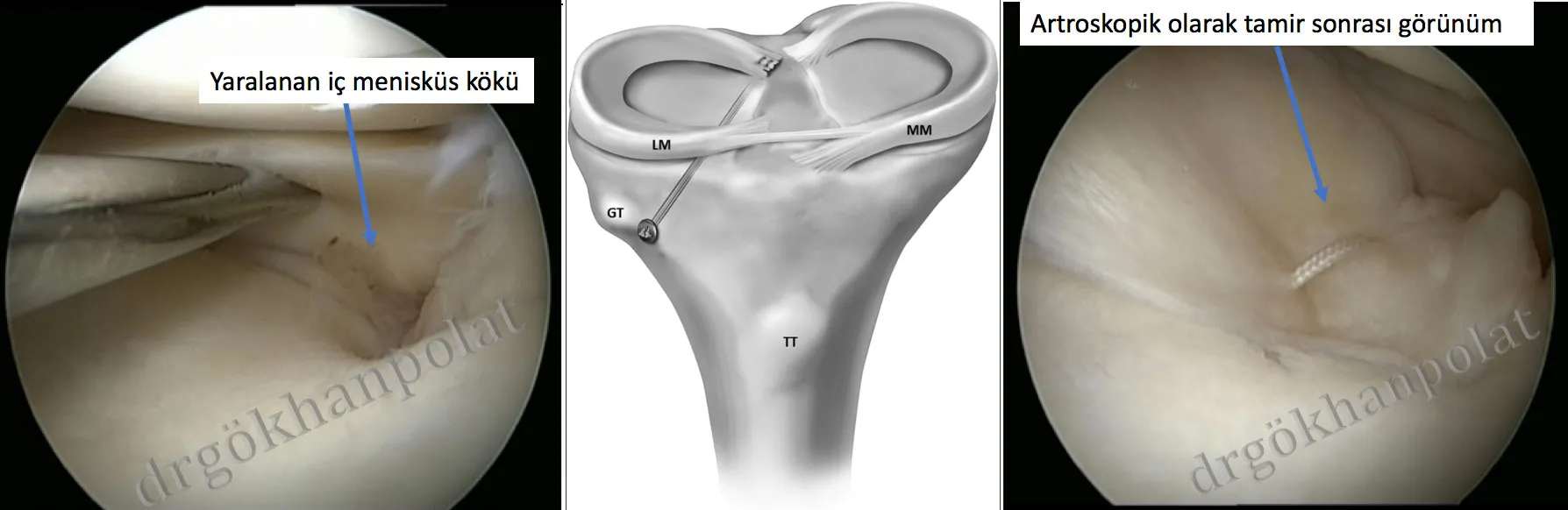
With appropriate patient selection and surgical technique, these tears can be repaired arthroscopically (closed) by passing suture threads through the posterior part of the meniscus, then threading them through bone tunnels and securing them on the bone surface. (Figure 1) For the meniscus tissue to reattach to the bone surface, heal, and regain its normal function, the patient must undergo a specialized rehabilitation period post-surgery.
The operation is usually done under spinal or general anaesthesia. A camera and fine instruments are introduced through a few small incisions at the front of the knee; the meniscus, cartilage and ligaments are inspected first, and any associated problem can often be addressed in the same session. Operating time and length of stay depend on what else needs to be done; most patients go home after a short stay.
Figure 1: Posterior root repair performed on the left knee of a 39-year-old male patient
Recovery and rehabilitation
Patients typically walk with crutches without bearing weight for 6 weeks post-surgery, and knee movement is restricted to 0-90 degrees for the first 4 weeks following the operation. The surgeon adjusts this framework to the technique used and any additional procedures.
- First 6 weeks: crutches without weight bearing, limited knee bending, swelling control and simple thigh-muscle exercises.
- After week 6: gradual weight bearing, increasing range of motion and supervised strengthening.
- From about month 3: broader daily activities, balance and endurance work.
- Sport and heavy activity: usually after several months, introduced step by step according to follow-up checks and muscle strength.
Deep squatting and sudden twisting are generally avoided during the first months. Recovery varies from person to person, depending on age, cartilage condition and adherence to rehabilitation. Our step-by-step guide to recovery after meniscus surgery offers further practical information.
Risks and possible complications
As with any operation, root repair carries some risks. They are uncommon but should be discussed beforehand:
- Infection
- Deep vein thrombosis (a blood clot in the leg veins)
- Stiffness or prolonged swelling
- The repair not healing as expected, or a re-tear
- Progression of existing cartilage wear over time
- Risks related to anaesthesia
Following the rehabilitation plan can help reduce these risks. Outcomes vary between individuals.
When should you see an orthopaedic specialist?
- Knee pain that starts after squatting or a sudden movement and does not settle within a few days
- Marked swelling, locking or inability to bear weight
- Pain that keeps increasing on stairs or when bending the knee
- Swelling with fever, redness and warmth (this needs urgent assessment)
Early assessment matters with root tears: an examination before cartilage damage progresses helps determine whether repair is suitable. For other tear patterns and their treatment, see our meniscus tears page; to arrange an examination, please use our contact page.
This article is for general information only; diagnosis and treatment decisions are made individually after examination and the necessary tests.
Frequently asked questions
Why does a meniscus root tear matter?
The menisci are attached to the tibia by anterior and posterior roots. After a root tear, especially at the back, the meniscus can shift out of the joint (extrusion) and lose its load-sharing function. This may lead to knee pain and cartilage wear, and over time to knee osteoarthritis.
Can a meniscus root tear heal without surgery?
A torn root is generally not expected to reattach to the bone on its own. Physiotherapy, activity changes and medication can ease symptoms, and this route may be preferred for people with advanced arthritis or those unsuitable for surgery. The right approach is decided after examination and MRI.
What causes a meniscus root tear?
Medial posterior root tears often occur from middle age onwards, when the meniscus has some wear and a simple movement such as squatting triggers the tear. Lateral root tears are more often seen in sports injuries, commonly together with an anterior cruciate ligament tear.
When can I put weight on my leg after meniscus root repair?
As a general framework, patients walk on crutches without bearing weight for about 6 weeks, and knee bending is limited to 0-90 degrees for the first 4 weeks. Weight bearing is then increased gradually. Timelines vary with the technique and any additional procedures.
What should I pay attention to after root repair surgery?
Follow the weight-bearing and movement limits, keep up with physiotherapy and attend follow-up visits. Deep squatting and sudden twisting are usually avoided for the first months. Contact your doctor if you notice increasing pain, fever, redness or calf swelling.
Is root repair suitable for everyone?
No. Repair is usually considered for people with symptoms, no advanced arthritis and no major malalignment of the leg. If alignment is abnormal, additional procedures such as an osteotomy may be discussed; in advanced arthritis other treatment options are considered.