
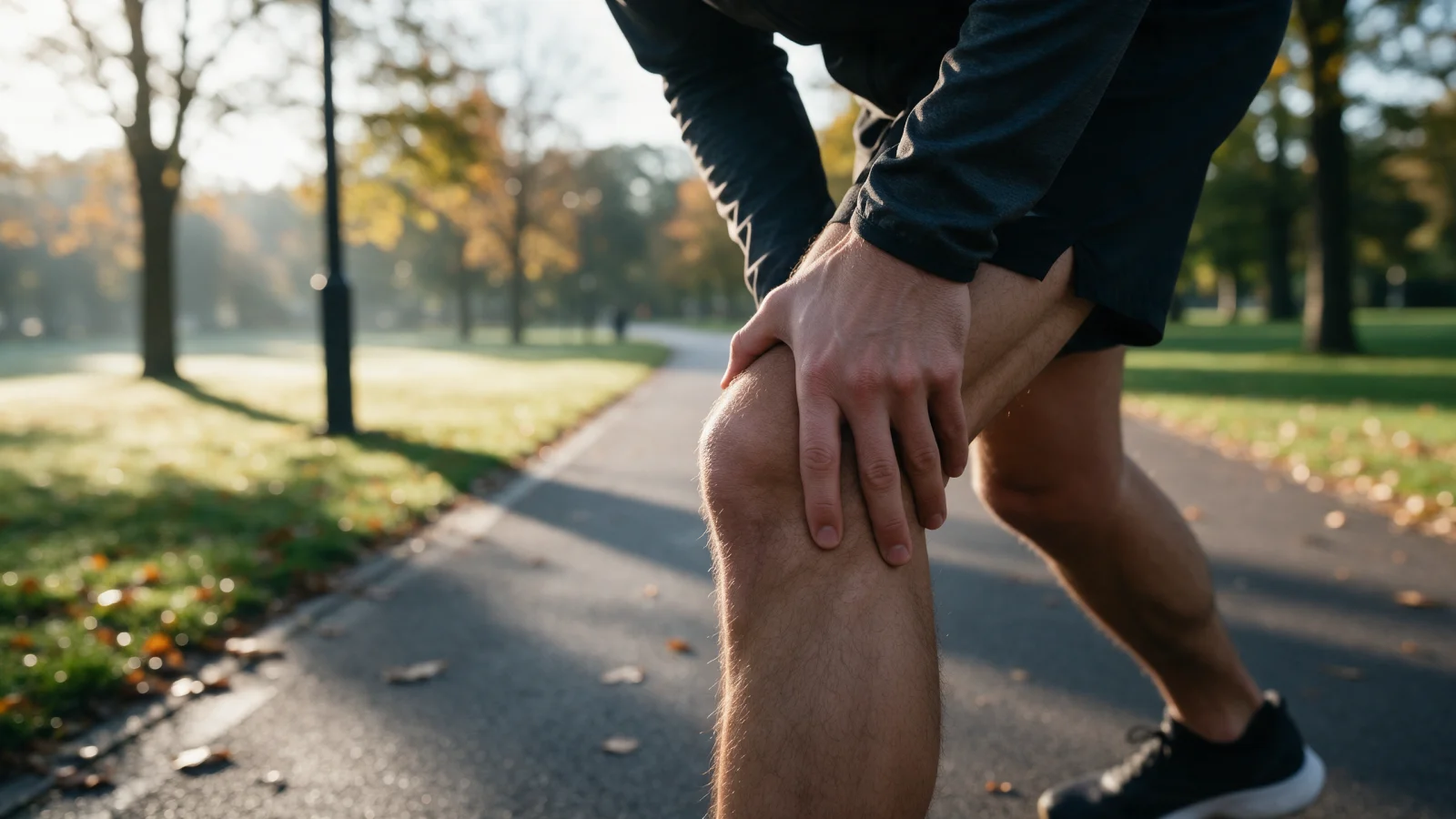
IT Band Syndrome (Runner's Knee): Pain on the Outer Knee
What causes iliotibial band syndrome (runner's knee) and how is it recognised? Risk factors, how it differs from other outer knee pain, exercises, treatment and a gradual return to running.
Iliotibial band syndrome is an overuse injury in which the thick strip of connective tissue running from the hip to the outside of the knee (the iliotibial band, or IT band) becomes irritated where it crosses the outer knee. It is common in runners, which is why it is often called "runner's knee". The typical pattern is a burning or sharp pain on the outside of the knee that starts after a certain time or distance into a run and gets worse going downhill or down stairs. Most people recover without surgery by adjusting their training and following an exercise programme that targets the hip muscles.
This article covers what the IT band does, why the syndrome develops, its symptoms, how it differs from other causes of outer knee pain, treatment and exercises, and how to return to running safely.
What is the IT band and how does the syndrome develop?
The IT band starts from muscles on the outside of the hip, mainly the tensor fasciae latae and gluteus maximus, runs down the outer thigh and attaches just below the knee on the shinbone. It helps stabilise the hip and knee from the outside when you walk and run.
When the knee bends to around 20–30 degrees, the band passes over the bony bump on the outer thigh bone (the lateral femoral epicondyle). Underneath it lies a layer of fat and nerve-rich tissue. Repeated bending and straightening compresses this area, causing irritation and pain. The old idea was that the band "rubs" over the bone; today the focus is more on repeated compression of the tissues beneath it.
Who gets it? Risk factors
- Training errors: increasing weekly mileage or pace too quickly, skipping rest days.
- Terrain: long downhill runs, always running on the same side of a cambered road, always turning the same way on a track.
- Weak hip muscles: especially the gluteus medius, which lets the knee drift inwards and loads the band.
- Running form: feet crossing the midline, overstriding.
- Other factors: a leg length difference, worn-out shoes, a bike saddle set at the wrong height.
Cyclists, hikers and anyone doing repetitive loaded activity can develop it too. We look at frequent training mistakes in our article on common exercise mistakes among athletes.
Symptoms of IT band syndrome
- Burning, stabbing or sharp pain on the outer knee, just above the joint line
- Pain that starts after a predictable time or distance and builds as you keep going
- Worse pain downhill, on stairs or when walking with the knee slightly bent
- Tenderness over the outer knee, sometimes mild swelling or a sense of snapping
- Pain that eases when you stop but returns at the same point on the next run
Swelling inside the joint, locking or the knee giving way are not typical and should prompt a search for other causes such as a meniscus or ligament injury.
What else can cause outer knee pain?
- Lateral meniscus tear: pain on the joint line, catching or swelling, often linked to twisting.
- Lateral collateral ligament sprain: usually after a blow or twist.
- Popliteus tendon problems: pain at the back-outer knee, especially downhill.
- Kneecap pain: patellofemoral problems are sometimes felt on the outer side.
- Stress fracture or pain referred from the hip: less common but important not to miss.
Some hip problems refer pain to the knee; our article on the differences between hip and knee pain explains how to tell them apart.
How is it diagnosed?
Diagnosis is usually made from your history and an examination. Your doctor will ask about your training and when the pain appears, check for tenderness over the outer knee, test the tightness of the band and the strength of your hip muscles, and watch how your knee moves during a single-leg squat. Imaging is not needed for everyone, but ultrasound or MRI may be requested if the diagnosis is unclear, symptoms last longer than expected or a meniscus, ligament or bone problem is suspected.
Treatment: load management and exercise
Early phase: settle the irritation
- Cut back the distance and pace that trigger pain; a break of a few days to a few weeks may be needed.
- Avoid downhill running and cambered surfaces for now.
- Keep your fitness with pain-free alternatives such as swimming.
- Apply a wrapped ice pack for 15–20 minutes to the sore area.
- Short-term anti-inflammatory painkillers may be used on medical advice.
Exercises for IT band syndrome
As the pain settles, a programme to strengthen the hip and trunk begins. Content and dosage should be tailored to you; typical exercises include:
- Side-lying leg raises with the top leg straight and slightly behind you, for the gluteus medius.
- Clamshells: lying on your side with knees bent, opening the top knee while keeping the feet together.
- Bridges, progressing to single-leg bridges.
- Side planks for trunk and hip control.
- Controlled single-leg squats and step-downs, watching in a mirror that the knee does not drift inwards.
- Outer hip and thigh stretches to ease the sense of tightness.
Foam rolling may feel good, but the band itself cannot really be "lengthened", so it should not be your only treatment. Our article on injury prevention through strength training explains why strength matters.
When are injections or surgery considered?
A corticosteroid injection beneath the band may be considered for selected patients whose pain persists despite a proper exercise programme. Surgery to release tension in the band is reserved for the rare cases that last for months and do not respond to any non-surgical treatment.
How to return to running
Progress by symptoms rather than by a set number of days. Being pain-free in daily life and able to do single-leg squats and hops without pain is usually the first milestone. Start with short, easy runs on flat ground and build distance gradually while monitoring pain; add downhill running and speed work last. Recovery time varies from person to person, and doing too much too soon is a common reason the pain comes back.
When should you see an orthopedic surgeon?
- Pain that has not eased after 3–4 weeks of reduced load and exercise
- Pain when walking, at rest or at night
- Swelling, locking, catching or the knee giving way
- Pain that began after a fall, blow or twist
- Pinpoint tenderness over bone or pain that clearly worsens with weight-bearing (possible stress fracture)
At Prof. Dr. Gökhan Polat's clinic, assessment combines your training history, the examination and, if needed, imaging, and the treatment plan is shaped around your sporting goals. Find out more on our sports injuries page.
Summary
- IT band syndrome (runner's knee) is an overuse pain on the outside of the knee.
- Sudden increases in training, downhill running and weak hip muscles are the main risk factors.
- Load management and hip and trunk strengthening are the core of treatment; injections and surgery are for selected cases.
- Swelling, locking, giving way or persistent pain suggest another cause that should be investigated.
This article is for general information only; diagnosis and treatment decisions are made individually after examination and the necessary tests.
FAQ
-
How long does IT band syndrome take to heal?
It varies from person to person depending on how long the pain has been present and how well the training load is adjusted. Mild cases caught early may improve noticeably within a few weeks, while long-standing pain can take a few months. Regular hip strengthening and a gradual return reduce the risk of it coming back.
-
Can I keep running with runner's knee?
Running at the distance and pace that bring on pain tends to keep the irritation going. It is usually better to switch to short, easy runs that stay below the point where pain starts, or to take a break of a few days to a few weeks. If pain starts during a run, stop and adjust the plan.
-
Which exercises help IT band syndrome?
Exercises that strengthen the hip and trunk, such as side-lying leg raises, clamshells, bridges and side planks, form the core of the programme. Controlled single-leg squats and step-downs are added later. The dose and order should be tailored to the individual.
-
Does foam rolling help the IT band?
Foam rolling can give some people a temporary feeling of relief and looseness. However, the IT band is very tough tissue and cannot be lengthened by rolling. It should be seen as an optional add-on to a strengthening programme rather than a treatment on its own.
-
Could pain on the outside of my knee be a meniscus tear?
Yes, a lateral meniscus tear can also cause outer knee pain. Meniscus pain is usually on the joint line and may come with swelling, catching or locking, whereas runner's knee pain starts with activity and settles with rest. The two are distinguished by examination and, if needed, MRI.