
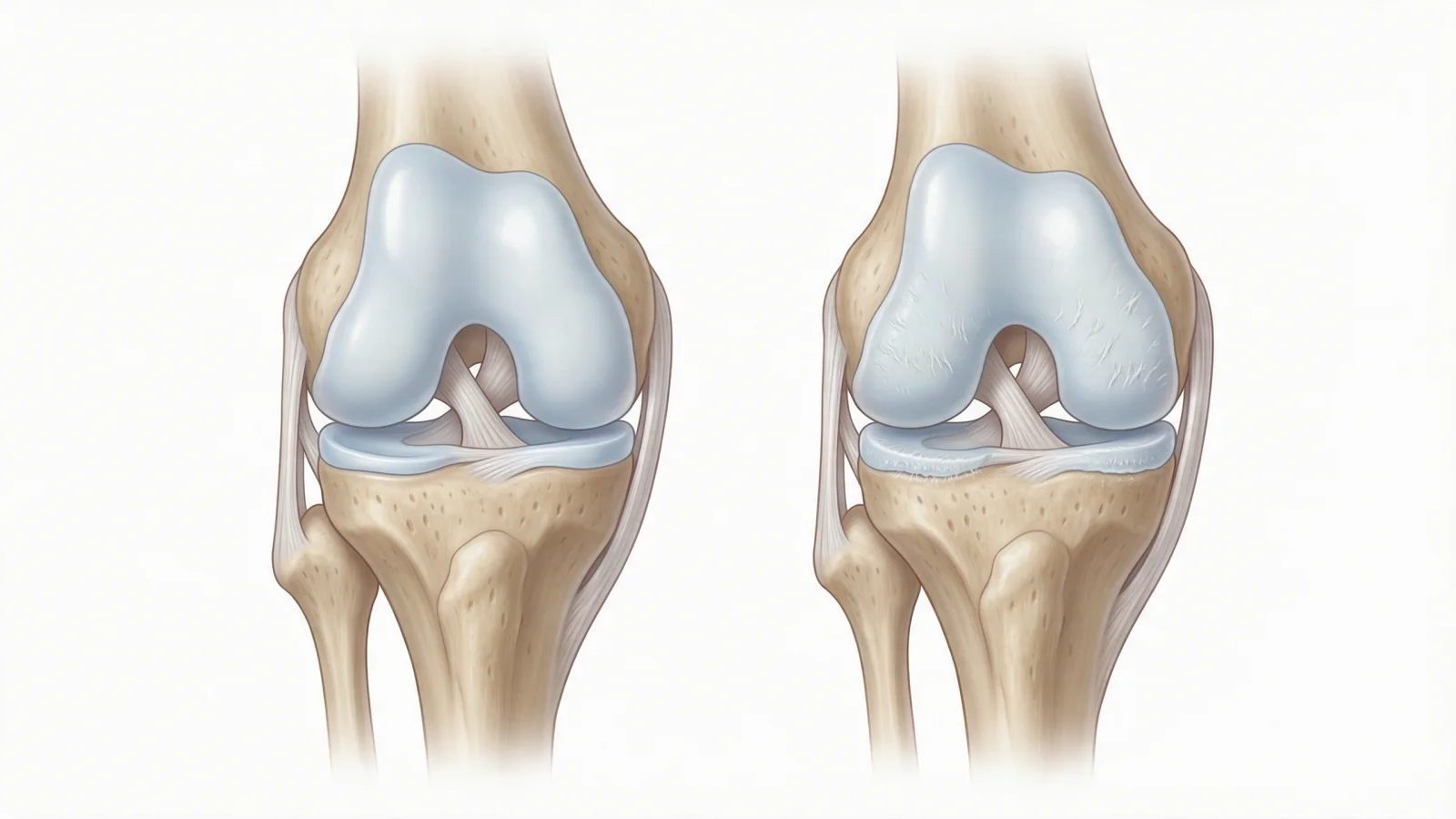
What Does Degeneration Mean on an MRI Report?
What does degeneration or degenerative change mean on a knee or hip MRI report? Meniscus, cartilage, tendon and labral degeneration explained, how it differs from a tear and what you can do.
Degeneration means that a tissue's structure has gradually broken down through age, repeated load and wear. On an MRI report, "degenerative change" indicates signs of wear in structures such as the meniscus, cartilage, tendons or the hip labrum. These findings are very common, especially after 40, are often in line with age, and are not on their own a reason for pain or for surgery. What matters is whether the MRI findings match your symptoms and examination.
This article explains what degeneration means, which knee and hip structures it is used for on MRI reports, how meniscal degeneration differs from a meniscus tear, whether degenerative changes progress and what can be done about them.
What is degeneration?
In medicine, degeneration is a general term for a tissue gradually losing its normal structure and function. In orthopedics it is used mostly for joint cartilage, menisci, tendons and the hip labrum. These tissues have a limited blood supply, so their ability to repair small injuries that accumulate over the years is also limited.
Degeneration is a description of a finding, not the name of a disease. Just as hair turns grey and skin wrinkles, some wear in the joints is expected with age. Seeing the word on your report does not mean there is a serious or urgent problem.
What speeds up degeneration?
- Age: tissues lose water content and elasticity.
- Excess weight: increases the load on the knees and hips.
- Previous injuries: meniscus tears, ligament injuries or fractures into the joint can accelerate wear over the years.
- Leg alignment: bow legs or knock knees concentrate load on one side of the joint.
- Hip shape problems: femoroacetabular impingement or hip dysplasia can lead to early wear.
- Repetitive heavy load: work or sport with lots of twisting, squatting or jumping.
- Weak muscles and inactivity: less muscular protection means more load on the joint.
- Genetics: a family history of early arthritis.
Which structures does the report mean?
Meniscal degeneration
The menisci are among the structures most often affected by age-related change. On MRI, bright areas inside the meniscus that do not reach its surface are reported as "increased signal" or "degenerative signal change", usually graded 1 or 2. This is not a tear. Meniscal degeneration often causes no symptoms, although a worn meniscus may tear with less force.
Tears that develop on this background are called degenerative meniscus tears. They often occur without a clear injury, for example when getting up from a squat, and are usually horizontal or complex. Without mechanical symptoms, treatment generally starts with physiotherapy and exercise.
Cartilage degeneration (chondromalacia)
Softening, thinning, fissuring or surface irregularity of joint cartilage may be reported as "chondral degeneration", "chondromalacia" or "cartilage thinning". Changes behind the kneecap are called chondromalacia patellae. As cartilage degeneration progresses it can turn into osteoarthritis. Read why early assessment matters in cartilage damage in the knee: why early intervention matters.
Tendon degeneration (tendinosis)
In tendons such as the patellar, quadriceps or gluteus medius tendon, disorganized fibers from long-term overload are reported as "tendinosis" or "degenerative tendinopathy". This is linked more to the tendon failing to adapt to load than to classic inflammation, and is usually managed with graded loading exercises.
Labral degeneration (hip)
The labrum, the ring of cartilage around the hip socket, can wear with age or because of hip shape problems. Reports may mention "degenerative labral signal" or a "degenerative labral tear". For symptoms and treatment, see hip labrum tear: symptoms, diagnosis and treatment.
Degenerative changes in bone
With advanced wear, the bone also changes: bone spurs (osteophytes) at the joint edges, hardening of the bone under the cartilage (subchondral sclerosis), small subchondral cysts and bone marrow edema. These are usually part of the osteoarthritis picture.
Degeneration at a young age
Degenerative changes are usually expected from middle age onwards. Marked cartilage or labral degeneration in someone in their 20s or 30s may call for a search for an underlying cause, such as an old injury that never fully healed, hip impingement or dysplasia, kneecap tracking problems or leg malalignment. Finding these early allows joint-preserving treatment options to be considered.
Do degenerative changes cause pain?
Not always. Studies have shown that many middle-aged and older people with no symptoms have degenerative changes in the meniscus, cartilage or tendons on MRI. The severity of MRI findings and the severity of pain often do not match: some people with marked changes have few complaints, while others with mild findings have significant pain. An examination is essential to find the real source of pain, taking into account where it hurts, which movements make it worse and whether there is swelling, locking or stiffness.
Does degeneration progress or reverse?
Degenerative changes usually do not reverse, but they do not always progress quickly either; many people stay at a similar level for years. The pace depends on weight, muscle strength, type of activity, alignment and previous injuries, and some of these can be changed:
- Losing excess weight reduces joint load.
- Strengthening thigh and hip muscles protects the joint and balances load.
- Low-impact activities such as walking, cycling and swimming support joint health.
- Limiting deep squats and sudden twisting that clearly increase pain may ease symptoms.
- Regular, controlled movement is better for joint nutrition than inactivity.
In selected younger patients with marked malalignment or hip shape problems, joint-preserving surgery to rebalance load may also be considered.
What treatment is available?
Treatment aims to ease symptoms and protect function, not to "fix" the MRI. It is usually stepwise: exercise and physiotherapy, weight management, activity changes, short courses of medication when needed and, in selected patients, joint injections. Surgery may be considered for tears causing mechanical symptoms, significant cartilage damage or advanced arthritis. For more information, visit our knee joint diseases page.
When should you see an orthopedic surgeon?
- Joint pain lasting several weeks that affects daily life
- Locking, catching, giving way or inability to straighten the knee
- Recurrent swelling
- Hip pain spreading to the groin, or difficulty putting on socks or tying shoes
- Steadily decreasing walking distance
- Night pain or pain that does not ease with rest
Urgent: sudden redness, warmth and swelling of a joint with fever, or inability to bear weight after a fall, need prompt assessment.
At Prof. Dr. Gökhan Polat's clinic, MRI reports are interpreted together with the images and the examination, and treatment plans take into account age, activity level and the patient's goals. Response to treatment varies from person to person.
Summary
- Degeneration is wear of tissues with age and load; seeing it on a report does not mean a serious or urgent problem.
- Degenerative signal change in the meniscus that does not reach the surface is not a tear.
- Degenerative changes do not always cause pain and should be interpreted alongside an examination.
- Weight control, muscle strengthening and regular movement are changeable factors that influence progression.
This article is for general information only; diagnosis and treatment decisions are made individually after examination and the necessary tests.
FAQ
-
What does degeneration mean?
Degeneration means a tissue gradually losing its structure and function through age, repeated load and wear. In orthopedics it is used mostly for menisci, cartilage, tendons and the hip labrum. It describes a finding rather than naming a disease.
-
Is meniscal degeneration a tear?
No. Signal change inside the meniscus that does not reach the surface indicates degeneration, not a tear. A worn meniscus may tear more easily, though, and signal reaching the joint surface is interpreted as a tear.
-
Are degenerative changes dangerous?
Usually not. Degenerative changes are very common, especially after 40, and are often found in people without symptoms. What matters is whether the findings match complaints such as pain, swelling or locking, which is assessed through an examination.
-
Can degeneration be treated?
Degenerative changes usually do not reverse, but treatment aims to ease symptoms and protect joint function. Exercise, weight control, activity changes and, when needed, medication or injections can help. Surgery may be considered for tears causing mechanical symptoms or advanced damage.
-
How can I slow down degeneration?
Losing excess weight, strengthening the thigh and hip muscles, doing regular low-impact activity such as walking, cycling or swimming and limiting movements that clearly increase pain may help. How fast changes progress varies from person to person.