
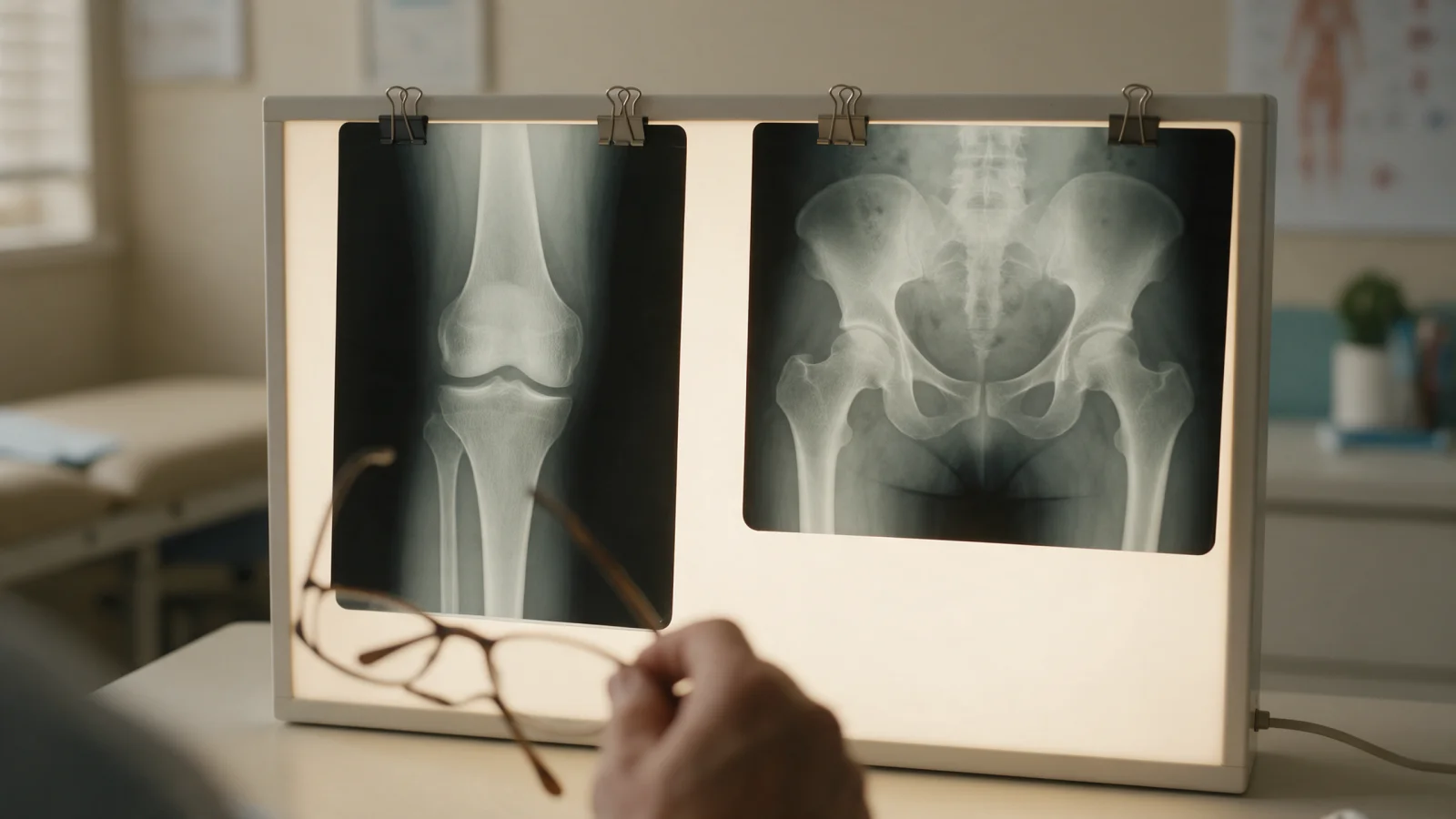
Gonarthrosis and Coxarthrosis: Arthritis Terms on Your Report
What are gonarthrosis and coxarthrosis? What these knee and hip arthritis terms mean, report findings such as joint space narrowing, osteophytes and subchondral sclerosis, the symptoms and treatment steps.
Gonarthrosis is the medical term for osteoarthritis of the knee, and coxarthrosis is osteoarthritis of the hip. Other phrases on reports, such as "degenerative arthritis", "osteoarthritis" and "arthrosis", describe the same process: gradual wear of joint cartilage and the changes in the surrounding bone that come with it. Seeing these terms on your report means there are signs of wear in the joint, but how severe it is, how it affects you and which treatment suits you are decided together with an examination.
This article explains what gonarthrosis and coxarthrosis mean, the terms that often accompany them on X-ray and MRI reports, such as joint space narrowing, osteophytes and subchondral sclerosis, the typical symptoms and what you can do after receiving your report.
What do gonarthrosis and coxarthrosis mean?
Medical words are usually built from Greek and Latin roots. "Gony" is Greek for knee, and "coxa" is Latin for hip, while "arthrosis" refers to a degenerative, wear-related joint condition. So:
- Gonarthrosis: knee osteoarthritis
- Coxarthrosis: hip osteoarthritis
- Bilateral gonarthrosis or coxarthrosis: arthritis in both knees or both hips
- Osteoarthritis, degenerative arthritis, arthrosis: different names for the same condition
Is arthrosis the same as arthritis?
Not exactly. "Arthritis" broadly means joint inflammation and includes inflammatory conditions such as rheumatoid arthritis, while "arthrosis" describes the wear-related process. Because osteoarthritis can also have an inflammatory component, the terms are sometimes used interchangeably, but conditions like rheumatoid arthritis need a different treatment approach. You can ask your doctor which meaning applies on your report.
What causes it?
Osteoarthritis without a clear cause, linked to age and genetics, is called primary; when it follows an earlier injury or joint problem it is called secondary. Risk factors include:
- Increasing age and a family history of arthritis
- Excess weight, especially for the knee
- Previous meniscus tears, meniscus removal or ligament injuries
- Bow legs or knock knees
- Hip shape problems such as femoroacetabular impingement or dysplasia
- Fractures extending into the joint
- Years of heavy lifting or work and sport involving frequent squatting
What do the report terms mean?
Gonarthrosis and coxarthrosis are usually diagnosed on standing X-rays. Typical accompanying findings include:
- Joint space narrowing: cartilage is invisible on X-ray, but the gap between the bones indirectly reflects its thickness; narrowing suggests cartilage loss.
- Osteophytes: bone spurs at the edges of the joint.
- Subchondral sclerosis: thickening and hardening of the bone just beneath the cartilage.
- Subchondral cysts: small cavities in the bone under the cartilage.
- Medial or lateral compartment: the inner and outer parts of the knee. "Medial-predominant gonarthrosis" means wear mainly on the inner side, often seen with bow legs.
- Patellofemoral arthrosis: arthritis between the kneecap and thigh bone, which can cause front-of-knee pain on stairs and when squatting.
- Grade or stage: severity may be graded from mild to advanced using systems such as Kellgren-Lawrence. Grades help planning, but the X-ray grade and the pain you feel do not always match.
MRI reports may also mention cartilage thinning, meniscal degeneration or extrusion, bone marrow edema and joint effusion.
Symptoms
Knee (gonarthrosis)
- Knee pain that worsens with activity and eases with rest
- Short-lived stiffness in the morning or when getting up after sitting
- Difficulty with stairs or getting up from a squat
- Grinding or crackling sensations
- Occasional swelling and, later, difficulty fully straightening or bending the knee
Hip (coxarthrosis)
- Groin pain, sometimes spreading to the front of the thigh and the knee
- Difficulty putting on socks, tying shoes or getting in and out of a car
- Reduced hip movement, especially turning inwards
- A limp and shorter walking distance
Hip arthritis can be felt in the knee, so the hip is examined in anyone with knee pain. For more detail, read what is hip osteoarthritis?
What should you do if your report says gonarthrosis?
It does not mean you need surgery straight away. The course varies, and many people stay active for years with the right measures. Treatment is usually stepwise:
- Exercise and physiotherapy: strengthening thigh and hip muscles and maintaining range of motion are the foundation.
- Weight management: losing excess weight reduces joint load.
- Activity changes: low-impact options such as walking, cycling and swimming.
- Medication: short courses of painkillers or anti-inflammatories when needed, on medical advice.
- Joint injections: may be considered for symptom control in selected patients.
- Surgery: osteotomy to correct alignment in younger, active patients, or joint replacement for advanced arthritis that seriously limits daily life.
Learn more about early signs and treatment in what is knee osteoarthritis?
Protecting your joints in daily life
- Avoid sitting in one position for long; get up for short walks.
- Choose slightly higher chairs and toilet seats rather than low ones.
- Wear cushioned shoes that hold the foot well.
- If you limp noticeably, a cane held in the hand opposite the painful side can reduce joint load.
- Spread heavy loads evenly between both hands, or use a wheeled bag.
- On bad days, shorten and lighten activity rather than stopping completely.
These measures do not reverse arthritis, but they can make daily life easier and help you keep up your exercise program.
Does it get worse over time?
Osteoarthritis generally progresses slowly, and the pace varies widely. Some people see little change for years, while others progress faster. Alongside age and genetics, factors you can influence, such as weight, muscle strength, activity level and alignment, also play a role. Pain often comes and goes, and a flare-up does not necessarily mean the disease has advanced.
When should you see an orthopedic surgeon?
- Knee or hip pain lasting several weeks that limits daily activities
- Steadily decreasing walking distance
- Pain that wakes you at night or does not ease with rest
- Recurrent knee swelling, locking or giving way
- Marked loss of hip movement or a limp
- A leg that is becoming increasingly bowed
Urgent: sudden redness, warmth and swelling of a joint with fever, or inability to bear weight after a fall, need prompt assessment.
At Prof. Dr. Gökhan Polat's clinic, treatment plans are based on X-ray and, if needed, MRI findings, the severity of symptoms, age, activity level and the patient's goals, and usually begin with non-surgical options. See our knee joint diseases and hip joint diseases pages for treatment options. Response to treatment varies from person to person.
Summary
- Gonarthrosis is knee osteoarthritis and coxarthrosis is hip osteoarthritis; osteoarthritis and degenerative arthritis describe the same process.
- Joint space narrowing, osteophytes and subchondral sclerosis are typical report findings.
- The X-ray grade and the level of pain do not always match; treatment is decided together with an examination.
- Treatment usually starts with exercise, weight control and activity changes; surgery is considered in selected patients.
This article is for general information only; diagnosis and treatment decisions are made individually after examination and the necessary tests.
FAQ
-
What does gonarthrosis mean?
Gonarthrosis is the medical term for osteoarthritis of the knee. It describes gradual wear of the knee cartilage and the bone changes that accompany it. When both knees are affected, reports call it bilateral gonarthrosis.
-
What is coxarthrosis?
Coxarthrosis is osteoarthritis of the hip. It typically causes groin pain, difficulty putting on socks or tying shoes and reduced hip movement. The pain can sometimes be felt in the knee.
-
Is degenerative arthritis the same as osteoarthritis?
Yes. Degenerative arthritis, osteoarthritis, arthrosis and wear-and-tear arthritis all describe the same process. Inflammatory conditions such as rheumatoid arthritis are different and need a different treatment approach.
-
Does gonarthrosis on my report mean I need surgery?
No, a diagnosis of gonarthrosis is not on its own a reason for surgery. Treatment usually starts with exercise, weight control and activity changes. Surgery is considered for selected patients whose symptoms seriously limit daily life despite other treatments.
-
What does joint space narrowing mean?
Cartilage does not show on X-ray, but the gap between the bones indirectly reflects its thickness. Narrowing of this gap suggests cartilage loss and is a typical sign of osteoarthritis. Its degree is used in grading arthritis.