
Hip Pain When Sitting: Common Causes and What Helps
Why does your hip hurt when you sit? Impingement, labral tears, arthritis, back and piriformis causes, what the location of the pain suggests, how to sit more comfortably and when to see a specialist.
Hip pain that gets worse when sitting most often comes from the hip joint itself, particularly femoroacetabular impingement (FAI) and the labral tears that can accompany it, because sitting puts the hip into deep flexion and loads the front of the joint. Lower back problems, piriformis syndrome, bursitis or tendon problems at the sitting bone and hip osteoarthritis can also cause pain that builds up while you sit. Exactly where you feel the pain is an important clue, but the diagnosis is confirmed by examination and appropriate imaging.
This article covers the main causes of hip pain when sitting, what the location of the pain suggests, how the diagnosis is made, how to adjust the way you sit, and when to see a specialist.
Why does sitting load the hip?
The hip is a ball-and-socket joint between the head of the thighbone and the socket (acetabulum) in the pelvis. Standing keeps it in a neutral position; sitting bends it to about 90 degrees, and even further in low chairs, car seats or when you cross your legs. In that position the neck of the thighbone moves closer to the front rim of the socket.
For many people with normally shaped hips this causes no trouble. But if there is a difference in bone shape or damage to the cartilage or labrum, prolonged sitting can create pressure and pain at the front of the joint. Sitting also increases the load on the discs of the lower spine and can compress muscles, nerves and bursae at the back of the hip, so "my hip hurts when I sit" can have several different sources.
What does the location of the pain suggest?
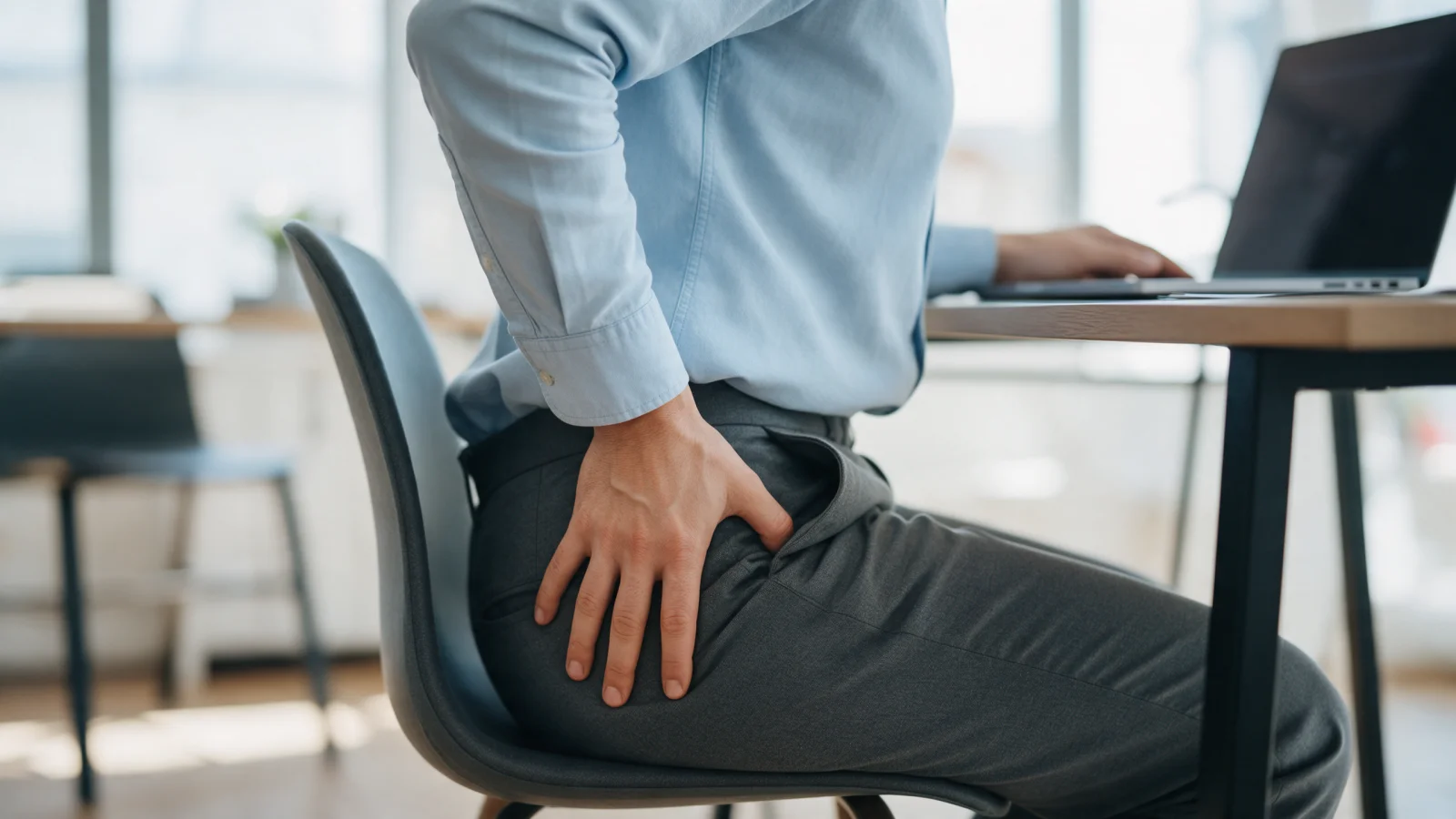
- Groin and front of the hip: usually the hip joint itself, with FAI, labral tears, osteoarthritis and iliopsoas tendinitis as the main causes. People often describe it by cupping the side of the hip with the hand in a "C" shape.
- Back of the hip and buttock: referred pain from the lower back, piriformis syndrome and sacroiliac joint problems.
- The sitting bone (the spot that digs in on a hard seat): bursitis or problems where the hamstring tendons attach.
- Outer side of the hip: trochanteric bursitis usually hurts more when lying on that side than when sitting.
The main causes of hip pain when sitting
Femoroacetabular impingement (FAI)
In FAI, extra bone on the head-neck junction of the thighbone or the rim of the socket makes the two surfaces collide when the hip bends, pinching the front of the joint. It mostly affects active young and middle-aged adults. Typical complaints are groin pain with prolonged sitting, in low chairs, when driving and when getting in and out of a car, difficulty crossing the legs and pain on deep squatting. Our article on how hip impingement affects daily life explains this in more detail.
Labral tear
The labrum is a ring of cartilage around the rim of the socket that seals the joint. It can tear as a result of FAI, repeated twisting or injury. Groin pain when sitting and on standing up may be accompanied by catching, clicking or locking. See our guide to hip labral tear symptoms.
Hip osteoarthritis
With hip arthritis, the first steps after sitting for a long time are often stiff and painful, easing after a few steps. Putting on socks and tying shoes may become harder. It is more common from middle age onwards.
Pain from the lower back
Because sitting increases pressure on the spinal discs, a herniated disc or other back problems can cause pain that worsens when sitting and spreads to the buttock and leg. Numbness, tingling and pain below the knee point towards the spine. Our article on telling hip pain from a herniated disc gives practical clues.
Piriformis syndrome and sitting-bone problems
When the deep piriformis muscle irritates the sciatic nerve, it can cause buttock pain that builds with sitting and symptoms that spread down the leg. Inflammation of the bursa over the sitting bone, or strain where the hamstring tendons attach, causes pinpoint pain, especially on hard seats.
Iliopsoas tendinitis
Irritation of the tendon of the main hip flexor can cause pain at the front of the groin, especially when standing up from a chair or lifting the leg, sometimes with a clicking sensation.
How is the cause diagnosed?
Assessment starts with a detailed history: where the pain is, which sitting positions make it worse, how long it has been present, its link to sport and any back or leg symptoms. The examination measures hip range of motion and includes specific tests such as bending and rotating the hip inwards to reproduce impingement, along with a back and nerve examination.
A hip X-ray is usually the next step, showing bone shape and arthritis. MRI or MR arthrography may be needed to assess the labrum and cartilage, and a lumbar spine MRI if the back is suspected. In some patients a diagnostic injection into the joint helps confirm whether the pain is coming from the hip.
Changing how you sit
- Seat height: sit with your hips slightly higher than your knees, so the hip bends less than 90 degrees; a wedge cushion can help.
- Avoid low, soft sofas that you sink into.
- Do not cross your legs or sit cross-legged on the floor.
- Take regular breaks: get up and walk for a few minutes every 30–45 minutes.
- Adjust your car seat: raising it slightly and reclining the backrest a little reduces hip bend; sit first, then swing both legs in together.
- For sitting-bone pain, a soft or cut-out cushion can reduce pressure.
Exercises recommended by your doctor or physiotherapist to strengthen the hip and core muscles can also help over time, while deep stretches that provoke the pain should not be forced.
Treatment options
Treatment depends on the cause. For FAI and labral tears, the first steps are usually activity modification, physiotherapy and medication, with a joint injection in selected patients. For those whose symptoms persist despite this and who have suitable findings, hip arthroscopy to reshape the bone and repair the labrum may be considered. Problems arising from the back, the piriformis or the sitting bone are treated differently. Response to treatment varies between individuals.
When should you see an orthopedic surgeon?
- Sitting pain that has not settled within a few weeks or keeps getting worse
- Catching, locking or clicking in the hip
- Pain that limits daily tasks such as putting on socks or getting into a car
- Pain that wakes you at night or does not ease with rest
- Numbness, weakness in the leg or changes in bladder or bowel control, which need urgent assessment
- Hip pain with fever, or being unable to bear weight
At Prof. Dr. Gökhan Polat's clinic, hip pain is assessed by looking at the location and character of the pain, examination and imaging findings, age and activity level together. To learn more about the causes and treatment of FAI, visit our femoroacetabular impingement page.
In summary
- Common causes of hip pain when sitting are FAI and labral tears; arthritis, back problems, piriformis syndrome and sitting-bone problems can feel similar.
- Groin pain points mostly to the hip joint, while buttock pain suggests the back or the muscles.
- Sitting with the hips higher than the knees, taking breaks and avoiding low seats can ease symptoms.
- Persistent pain, catching or numbness in the leg needs an examination.
This article is for general information only; diagnosis and treatment decisions are made individually after examination and the necessary tests.
FAQ
-
Why does my hip hurt when I sit?
The commonest causes are hip impingement and labral tears, because sitting bends the hip and loads the front of the joint. Hip arthritis, a herniated disc, piriformis syndrome and bursitis at the sitting bone can also cause pain that builds while sitting. An examination is needed to tell them apart.
-
What does groin pain when sitting mean?
Groin pain when sitting usually comes from the hip joint itself. In young, active people impingement and labral tears are most likely; in older adults, hip arthritis. Because non-hip causes such as a hernia are also possible, an assessment is worthwhile.
-
How should you sit if you have hip pain?
Choose a supportive chair that keeps your hips slightly higher than your knees and avoid low, soft seats. Do not cross your legs, and get up for a short walk every 30–45 minutes. A wedge cushion can reduce how far the hip bends.
-
Can hip pain when sitting come from the back?
Yes. Sitting increases pressure on the spinal discs, so a herniated disc can cause pain at the back of the hip and down the leg. Numbness, tingling and pain below the knee suggest the back. A combined hip and spine examination helps tell them apart.
-
Does hip impingement need surgery?
Not every case of impingement needs surgery. The first steps are usually activity modification, physiotherapy and medication. Hip arthroscopy may be considered for people whose symptoms persist despite this and who have suitable findings, and the decision is individual.