
Who Is Not a Good Candidate for Hip Arthroscopy?
Hip arthroscopy is generally not suitable for advanced arthritis, significant dysplasia, pain from outside the joint or active infection. Learn why patient selection matters, the possible risks and what to ask.
Hip arthroscopy is generally not a suitable option for people with advanced hip arthritis, a markedly shallow hip socket (dysplasia), pain that does not originate inside the hip joint or general health issues such as an active infection. In these situations the expected benefit may be limited, or symptoms may even worsen. The patients most likely to benefit are those with a preserved joint space, pain caused by a mechanical problem such as impingement or a labral tear, and an inadequate response to non-surgical treatment.
This article explains why careful patient selection matters so much, the situations in which hip arthroscopy is not recommended or needs cautious assessment, the possible risks of the operation and the questions you can ask your surgeon before deciding.
Why does patient selection matter so much?
Hip arthroscopy is a valuable joint-preserving procedure that aims to reduce pain and protect the joint in the right patient. But not every hip pain comes from a problem that arthroscopy can address. One of the biggest influences on the outcome is not only the technique itself but whether it is used in the right patient for the right reason.
Arthroscopy in an unsuitable patient can mean ongoing pain, a rehabilitation period that achieves little and, in some cases, added stress on the joint. That is why "who should not have it?" is as important a question as "who should?". You can read more about when arthroscopy is preferred on our hip arthroscopy page.
When is hip arthroscopy generally not recommended?
Advanced hip arthritis
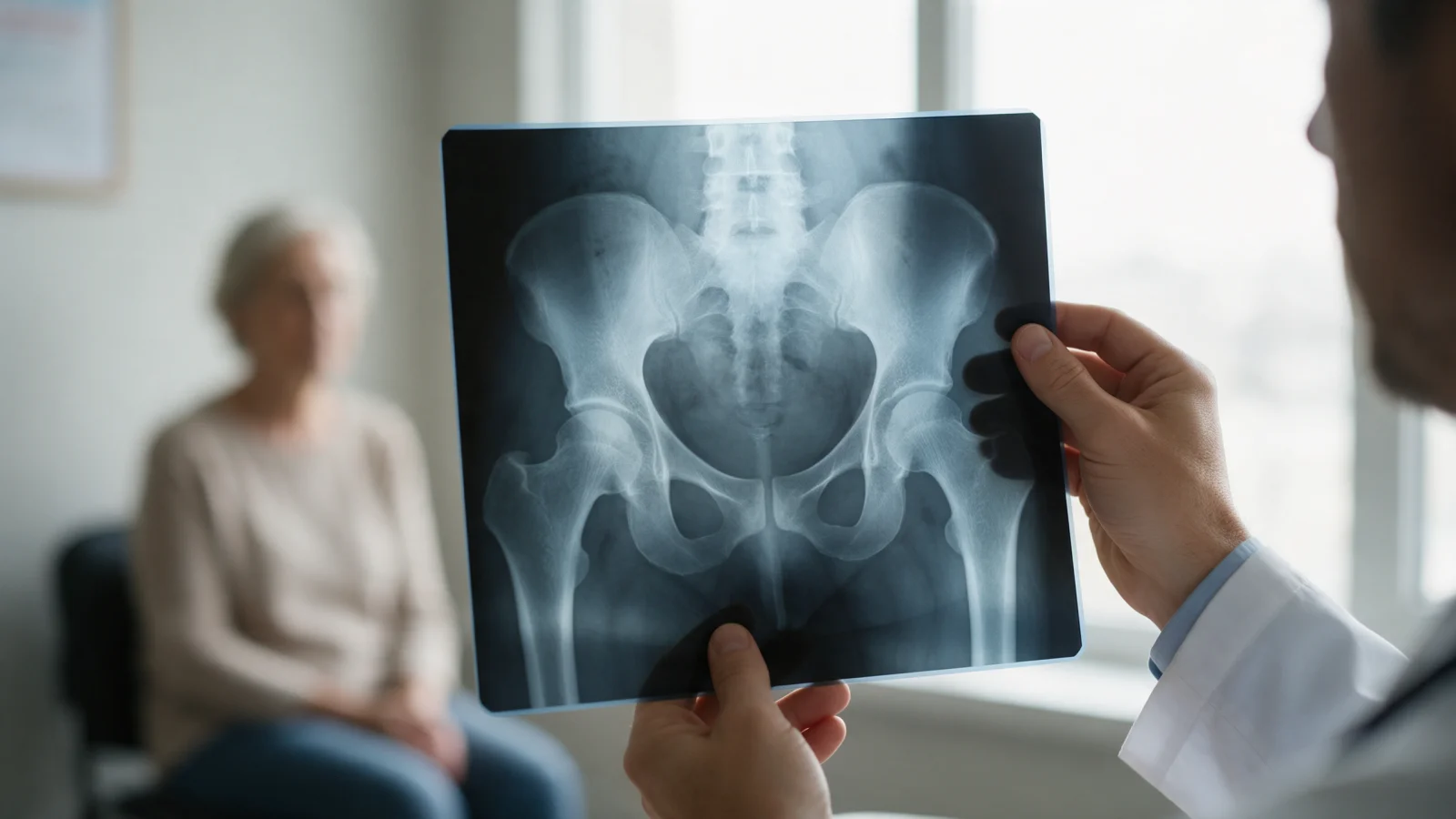
When cartilage is widely worn and the joint space has clearly narrowed on X-ray, arthroscopy does little to relieve pain. Symptoms are more likely to persist and a replacement may be needed soon afterwards. For advanced arthritis that no longer responds to non-surgical care, hip replacement is usually discussed instead.
Significant hip dysplasia
In dysplasia the socket does not cover the femoral head adequately, and the main problem is instability rather than impingement. Arthroscopy alone can increase that instability, particularly after work on the bone or joint capsule. Operations that reorient the socket, such as a pelvic osteotomy, are favoured in significant dysplasia; in borderline cases, arthroscopy is considered only after careful assessment and with an appropriate technique. Our article on acetabular dysplasia and its treatment explains more.
When the pain does not come from inside the joint
Not all pain felt around the hip comes from the hip joint. Nerve compression from a disc herniation or spinal stenosis, sacroiliac joint problems, hernias and some internal organ conditions can mimic hip pain. A small labral tear seen by chance on MRI may not be the real source. If examination and tests cannot show that the pain comes from inside the joint, an arthroscopy inside the joint is unlikely to help. A diagnostic local anaesthetic injection into the joint can be useful in making this distinction.
Avascular necrosis with collapse of the femoral head
Once the femoral head has collapsed because of disrupted blood supply, the joint surface is damaged and arthroscopy cannot correct it. Other treatments are considered depending on the stage.
General health barriers
- An active infection in the hip area or elsewhere in the body
- Uncontrolled heart, lung or clotting problems that significantly raise surgical risk
- Severe obesity that makes the operation technically difficult and slows recovery (a relative barrier, assessed individually)
- A very stiff hip with severely restricted movement
When rehabilitation is not feasible or expectations are unrealistic
Recovery after hip arthroscopy may involve weeks on crutches and months of regular physiotherapy. Results may suffer in people who cannot commit to this or follow the advice given. Realistic expectations matter too: arthroscopy does not reverse arthritis, and it does not mean pain will disappear completely in every patient.
When is extra caution needed?
Some situations do not rule arthroscopy out but call for a more detailed discussion:
- Mild to moderate early arthritis together with mechanical symptoms
- Older age with associated cartilage damage
- Generalised joint hypermobility
- Long-standing chronic pain accompanied by widespread body pain
- Persistent symptoms after a previous hip arthroscopy
In these patients the possible benefit and risks are weighed more carefully, and non-surgical options are usually tried fully first.
So who may be a suitable candidate?
Knowing who should not have arthroscopy also clarifies who may benefit. In general, it may be considered when the following come together:
- Examination and tests show that the pain comes from inside the hip joint
- There is a problem arthroscopy can address, such as impingement, a labral tear or limited cartilage damage
- The joint space is preserved on X-ray
- Symptoms that limit daily life or sport persist despite consistent non-surgical care
- The patient can commit to rehabilitation and has realistic expectations
Even when these criteria are met, the decision is made after an open discussion of possible benefits and risks.
What are the risks of hip arthroscopy?
Serious complications are uncommon when hip arthroscopy is performed in a suitable patient, but as with any surgery the risks are not zero and should be discussed openly beforehand. They include:
- Temporary numbness: The traction used to open the joint during surgery can cause usually temporary changes in sensation in the groin, thigh or foot.
- Blood clots: There is a risk of clots in the leg veins, and preventive measures are taken according to individual risk.
- Infection: Uncommon; preventive measures are used before and during surgery.
- Heterotopic ossification: Unwanted bone formation in the soft tissues around the hip can occasionally occur.
- Joint instability: Rare, mainly in patients with structural risk factors.
- Persistent symptoms or further surgery: In some patients pain does not ease as hoped, and an additional procedure or, in later years, a replacement may be needed.
For more detail on complications and how they are minimised, see complications in arthroscopic hip surgery.
Questions to ask before deciding on surgery
- How do we know my pain comes from inside the joint?
- What do my X-ray and MRI show about the joint space and cartilage?
- Is my socket coverage adequate, or is there dysplasia?
- Have I tried non-surgical options sufficiently?
- What does recovery involve, and how long will I need physiotherapy?
- What are realistic expectations from arthroscopy in my case?
At Prof. Dr. Gökhan Polat's clinic, the decision to operate is made together with the patient, based on examination findings, X-ray and MRI, a diagnostic injection where needed, age, activity level and personal goals. When arthroscopy is not thought to be suitable, alternative treatments are discussed. Outcomes vary from person to person.
When should you see an orthopedic surgeon?
- Groin pain lasting several weeks that is worse when sitting or bending the hip
- Catching, locking or loss of hip movement
- Arthroscopy has been recommended and you would like detailed information before deciding
- Pain after hip arthroscopy that lasts longer than expected or is getting worse
Seek urgent care if: after surgery you notice redness, discharge or fever at the wound, one-sided calf swelling and pain, or sudden shortness of breath or chest pain. Being unable to bear weight after a fall is also a reason for urgent assessment.
In summary
- Hip arthroscopy is generally not suitable in advanced arthritis, significant dysplasia, pain from outside the joint or active infection.
- Those most likely to benefit have a preserved joint space, mechanical pain and an inadequate response to non-surgical care.
- Serious complications are uncommon but the risks are not zero and should be discussed openly.
- Careful patient selection is one of the most important factors in the outcome.
This article is for general information only; diagnosis and treatment decisions are made individually after examination and the necessary tests.
FAQ
-
What are the risks of hip arthroscopy?
Serious complications are uncommon in suitable patients. Possible risks include usually temporary numbness from the traction used during surgery, blood clots, infection, unwanted bone formation in soft tissues, rare joint instability and the need for further surgery if symptoms persist. Risks should be discussed individually before surgery.
-
Can people with hip arthritis have arthroscopy?
In advanced arthritis with clear joint space narrowing, arthroscopy offers limited benefit and is generally not recommended. In selected patients with mild early arthritis and mechanical symptoms such as catching, the decision is made after a detailed discussion of the possible benefits and limits.
-
Is there an age limit for hip arthroscopy?
There is no fixed age limit; the decision depends mainly on the condition of the joint. Because cartilage damage and arthritis are more common with age, the likelihood of benefit is assessed more carefully in older patients. In those with a preserved joint space and mechanical pain, age alone is not a barrier.
-
Can hip arthroscopy be done for hip dysplasia?
In significant dysplasia the main problem is instability, and arthroscopy alone can make it worse, so operations that reorient the socket, such as a pelvic osteotomy, are favoured. In borderline dysplasia, arthroscopy may be considered only after detailed assessment and with an appropriate technique.