
Achilles Tendon Rupture: Symptoms, Thompson Test and Treatment
How is an Achilles tendon rupture recognised? The typical symptoms, the Thompson test, when imaging helps, how surgery and non-surgical treatment are compared, and what recovery looks like.
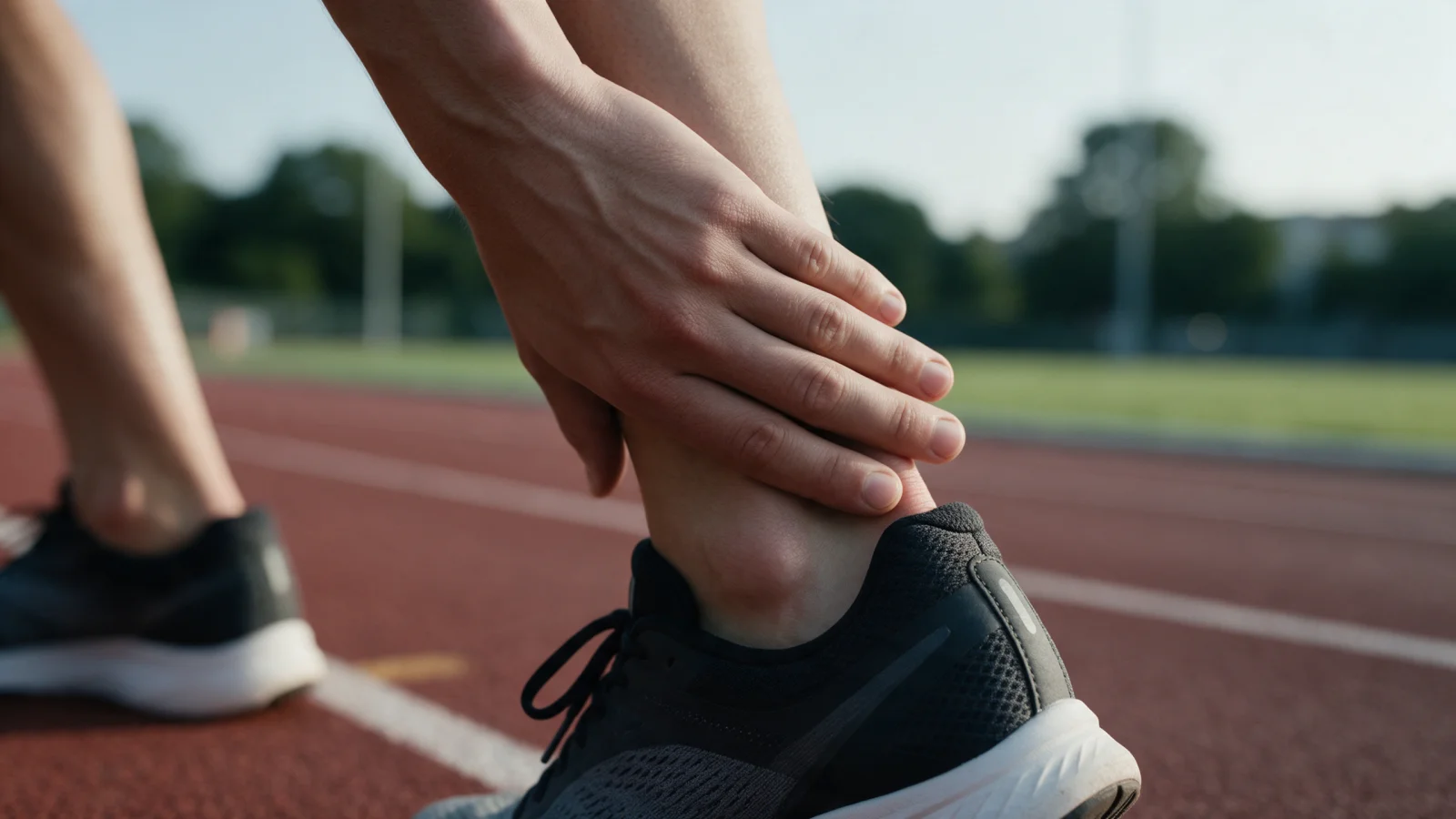
An Achilles tendon rupture is a partial or complete tear of the thick tendon that connects the calf muscles to the heel bone. The classic sign is a sudden blow to the back of the heel, as if someone had kicked you, sometimes with an audible "pop", followed by an inability to rise onto your toes. Diagnosis is usually made in the clinic with simple tests such as the Thompson test, and treatment can be surgical or non-surgical depending on your age, activity level and the features of the tear.
This article explains how the tendon ruptures, which symptoms point to it, what the examination involves, how the choice between surgery and non-operative care is made, and what the road back to walking generally looks like.
What is the Achilles tendon and how does it rupture?
The Achilles is the largest and strongest tendon in the body. It links the gastrocnemius and soleus muscles to the heel and transmits the force that pushes the foot down when you walk, run, jump or stand on tiptoe. Despite its strength, it is vulnerable a few centimetres above the heel, where its blood supply is relatively poor.
Most ruptures happen during a sudden push-off, jump or change of direction, when the calf contracts hard and the tendon meets an unexpected load. Tennis, squash, badminton, basketball, football and volleyball are typical settings, but missing a step on the stairs or stepping into a hole can also do it.
Who is at higher risk?
- "Weekend warriors", often between 30 and 50, who are inactive during the week and play hard at weekends
- People with long-standing pain at the back of the heel (Achilles tendinopathy)
- Anyone who sharply increases their training load
- People who have had corticosteroid injections around the tendon
- People taking, or recently treated with, fluoroquinolone antibiotics
- Conditions that affect tendon tissue, such as inflammatory arthritis, diabetes or kidney failure
Months of heel pain and morning stiffness can mean the tendon is already weakened. Our article on Achilles tendon problems in athletes covers these earlier stages in more detail.
What are the symptoms of an Achilles rupture?
Most people remember the exact moment of injury, and many turn around expecting to see someone who hit them. Common symptoms include:
- Sudden, sharp pain and a feeling of impact at the back of the heel or lower calf
- A snap or pop heard or felt at the time of injury
- Being unable to rise onto the toes, especially on one leg
- Loss of push-off when walking, with a flat-footed gait
- Swelling and, over the following days, bruising behind the heel
- In some cases, a gap you can feel along the tendon
Crucially, most people can still walk after a complete rupture, because other muscles can point the foot downwards. "I can walk, so it can't be torn" is therefore a misleading assumption, and the pain often settles quickly too. This is why Achilles ruptures are sometimes mistaken for an ankle sprain and missed.
The Thompson test and the clinical examination
In most cases a careful examination is enough to recognise a rupture. The doctor asks how the injury happened, feels along the tendon and compares both legs.
Thompson test
You lie face down with your feet hanging over the edge of the couch, and the doctor squeezes your calf. With an intact tendon, the foot moves downwards. When the tendon is completely torn, this movement is absent or clearly reduced. It is one of the most useful signs of a full rupture.
Other signs
- Knee-bend test: lying face down with both knees bent to 90 degrees, the injured foot hangs more upright than the healthy one.
- Palpable gap: a dip may be felt along the tendon, although swelling can hide it.
- Single-leg heel raise: usually impossible with a complete tear.
When are ultrasound or MRI needed?
When the findings are clear, imaging is often unnecessary. Ultrasound or MRI may be requested if the signs are equivocal, a partial tear is suspected, the injury is not recent, or the gap between the tendon ends matters for planning. Ultrasound can also show how well the ends come together when the foot is pointed. A firm diagnosis comes from combining the examination with imaging where needed.
What should you do straight away?
- Stop the activity and avoid putting weight on the leg.
- Elevate the leg and apply a towel-wrapped ice pack for 15–20 minutes at a time.
- Do not stretch the foot upwards; a slightly pointed position is usually more comfortable.
- Use crutches if available and see an orthopedic surgeon the same day or within a few days.
Early assessment matters, because starting treatment in the first days helps the tendon ends heal in a good position, whichever approach is chosen. For general principles, see our guide to first aid for sports injuries.
Surgery or non-surgical treatment?
There is no single right treatment for every Achilles rupture. Research in recent years has shown that, in suitable patients, non-operative care with functional rehabilitation, based on early movement and controlled weight bearing, can also achieve good results. The decision is therefore individual and shared with the patient.
Non-operative treatment
The foot is held in a walking boot with heel wedges, or in a cast, so that the tendon ends sit close together. The wedges are removed step by step over several weeks while weight bearing increases under a physiotherapy programme. It avoids surgical wound problems, but it requires strict adherence, and tendon lengthening or re-rupture must be watched for.
Surgical repair
The torn ends are stitched together through an open incision or with minimally invasive techniques using smaller cuts. Surgery tends to be considered more strongly for:
- High-level athletes and people returning to explosive sports
- A significant gap that persists even with the foot pointed
- Ruptures diagnosed late, several weeks after injury
- Re-rupture of a previously treated tendon
- Tears at the point where the tendon attaches to the heel bone
Surgery has its own risks, including wound healing problems, infection and irritation of a nerve that can change sensation on the outer side of the foot; smoking, diabetes and poor circulation increase them. In Prof. Dr. Gökhan Polat's clinic, the choice is based on the location of the tear, the size of the gap, the time since injury, age, general health and sporting goals.
Walking and recovery after Achilles treatment
Recovery is gradual whichever route is taken. The timeline below is only a general guide and varies with the protocol used and with each person.
- First weeks: the foot is protected in a boot with heel wedges. Many current protocols allow early weight bearing in the boot as advised by the surgeon; crutches are usually needed.
- Around weeks 6–10: the wedges are reduced and the boot is phased out, while physiotherapy restores ankle movement and begins gentle strengthening.
- Around months 3–6: calf strengthening, balance work and a normal walking pattern are the goals; light jogging is considered towards the end of this phase if strength allows.
- After six months: return to jumping and cutting sports is planned once strength and function tests are adequate, which can take up to a year for some people.
Calf strength can take a long time to recover fully, and recovery varies from person to person. Our article on when an injured athlete should return to sport explains why functional criteria matter more than the calendar.
When should you see an orthopedic surgeon?
An Achilles rupture should not be left to "see how it goes". Seek assessment promptly if you have:
- A sudden blow sensation or pop behind the heel during sport or a quick movement
- Inability to rise onto the toes on one leg
- Swelling, bruising or a palpable dip behind the heel
- Loss of push-off that has not improved a few days after a suspected sprain
- Redness, discharge or fever around a surgical wound
- One-sided calf swelling, tightness and pain during the cast or boot phase, which can signal a blood clot and needs urgent care
To learn more about how tendon and ligament injuries are assessed and treated, visit our sports injuries page.
In summary
- Achilles ruptures usually happen during a sudden jump or push-off; a blow sensation behind the heel and inability to stand on tiptoe are typical.
- Being able to walk does not rule out a rupture; the Thompson test is one of the most helpful signs.
- Treatment may be surgical or non-operative with functional rehabilitation, chosen individually.
- Recovery takes months and varies between people; early assessment keeps all options open.
This article is for general information only; diagnosis and treatment decisions are made individually after examination and the necessary tests.
FAQ
-
How do I know if my Achilles tendon is torn?
The classic signs are a sudden feeling of being kicked behind the heel, sometimes with a pop, followed by an inability to rise onto your toes on one leg. Swelling, bruising and a dip along the tendon may also appear. Being able to walk does not rule out a rupture; the diagnosis is made by examination, with ultrasound or MRI if needed.
-
Can an Achilles rupture heal without surgery?
In suitable patients, yes. Non-operative care with a heel-wedged boot and functional rehabilitation based on early weight bearing can give good results. Surgery may be favoured for late diagnosis, a persistent gap between the tendon ends or high-level sporting goals. The decision is made individually after examination.
-
When can I walk after Achilles surgery?
Many current protocols allow partial weight bearing in a heel-wedged boot during the first weeks, as advised by the surgeon. The boot is usually phased out over a few months and a normal walking pattern is regained with physiotherapy. Timelines vary with the protocol and with each person's healing.
-
What is the Thompson test?
You lie face down with your feet over the edge of the couch while the doctor squeezes the calf. With an intact tendon the foot moves downwards; with a complete rupture the movement is absent or clearly reduced. It is a simple test but one of the most useful signs of an Achilles rupture.
-
Can the Achilles tendon rupture again?
A treated tendon can rupture again, with the risk highest in the early months of healing and when rehabilitation steps are skipped. Following the boot, weight-bearing and exercise plan, and returning to sport only once calf strength is adequate, helps reduce this risk, which varies between individuals.