
Patellar Tendinitis (Jumper's Knee): Pain Below the Kneecap
What is patellar tendinitis (jumper's knee)? Causes and symptoms of pain below the kneecap in jumping athletes, how it is diagnosed, progressive exercise treatment and return-to-sport criteria.
Patellar tendinitis, often called jumper's knee, is an overload problem of the patellar tendon, the strong band that connects the kneecap to the shinbone. Its hallmark is pain just below the kneecap that flares when you jump, land, squat or walk downstairs. Most people improve with a sensible reduction in load followed by a progressive strengthening programme, but recovery usually takes weeks to months rather than days.
This guide explains why the tendon becomes painful, which symptoms to look out for, how the diagnosis is made, what treatment involves step by step, and how athletes can plan a safe return to their sport.
What is the patellar tendon and why does it get overloaded?
The patellar tendon transmits the force of the quadriceps, the large muscle at the front of the thigh, through the kneecap to the shinbone. Every time you take off for a jump it helps straighten the knee, and every time you land it acts like a spring that brakes the body. Landing in particular puts loads of several times body weight through this small structure.
Tendons adapt to load, but when the demand repeatedly outpaces the tendon's ability to recover, microscopic changes develop inside it. That is why many clinicians now prefer the term "tendinopathy" to "tendinitis": the problem is less a classic inflammation and more a failed healing response to overload. The distinction matters, because treatment is built around making the tendon tolerate load again, not simply calming inflammation.
Who is most at risk?
Jumper's knee is most common in young adults who play sports with repeated jumping and quick changes of direction. Typical risk factors include:
- The sport itself: basketball, volleyball, handball, high and long jump, football and tennis
- Sudden jumps in training load: pre-season camps, extra weekly sessions or a congested match schedule
- Hard playing surfaces
- Muscle imbalance: tight quadriceps and hamstrings or weak hip muscles
- Landing technique: stiff landings with too little knee bend
- Body weight and poor recovery: extra weight, short sleep and too little rest between sessions
We look at other knee risks on the court in our article on why the knee is the most at-risk joint for basketball players. In growing children, pain below the kneecap can instead come from the growth area where the tendon attaches to the shinbone, which is a different condition and needs its own assessment.
What are the symptoms of patellar tendinitis?
The pain is usually felt at the lower tip of the kneecap and is often so localised that you can point to it with one finger. Common features are:
- Pain below the kneecap during jumping, landing, sprinting or squatting
- Pain on standing up after sitting for a long time with bent knees, such as in a cinema or on a long drive
- Discomfort walking downstairs
- Tenderness when pressing on the lower edge of the kneecap
- Pain at the start of training that eases as you warm up, then returns once you cool down
That warm-up effect can be misleading. Pain that fades during exercise does not mean the tendon has healed, and if the load stays the same, symptoms tend to start earlier and last longer over time. In more advanced cases pain may appear in daily life and clearly limit performance.
How is it diagnosed?
Diagnosis rests mainly on a careful history and examination. Your doctor will ask where the pain is, how it began, which activities make it worse and whether your training has changed recently. The examination checks tenderness where the tendon meets the kneecap, whether loading tests such as a single-leg squat reproduce the pain, muscle flexibility and the mechanics of the hip and ankle.
When needed, ultrasound or MRI can show tendon thickening, structural change or a partial tear. Imaging also helps rule out other causes of front-of-knee pain, such as cartilage problems behind the kneecap, meniscus tears or bursitis, which call for a different approach.
Treatment: progressive load management
The aim is not to rest the tendon completely, which can weaken it further, but to reduce load enough to settle the pain and then rebuild the tendon's capacity step by step. A typical programme moves through these stages:
- Adjusting load: jumping and sprinting that clearly aggravate the pain are reduced for a while; cycling or swimming can help maintain fitness.
- Isometric exercises: holding a static contraction, for example a wall sit at a comfortable angle, often helps ease pain.
- Heavy, slow strengthening: squats, leg press and slow decline squats build tendon capacity over a number of weeks.
- Spring-like loading: hops, small jumps and landing drills are added gradually as the tendon gets stronger.
- Sport-specific return: jumping, cutting and match intensity are reintroduced in stages.
Mild discomfort during exercise that settles by the next day is generally acceptable, but pain that is clearly worse the following morning means the load was too high. Working with a physiotherapist helps find the right dose and correct technique. Strengthening the hip and thigh muscles is also part of the plan, as explained in our article on why strengthening the muscles around the knee matters.
Supporting options
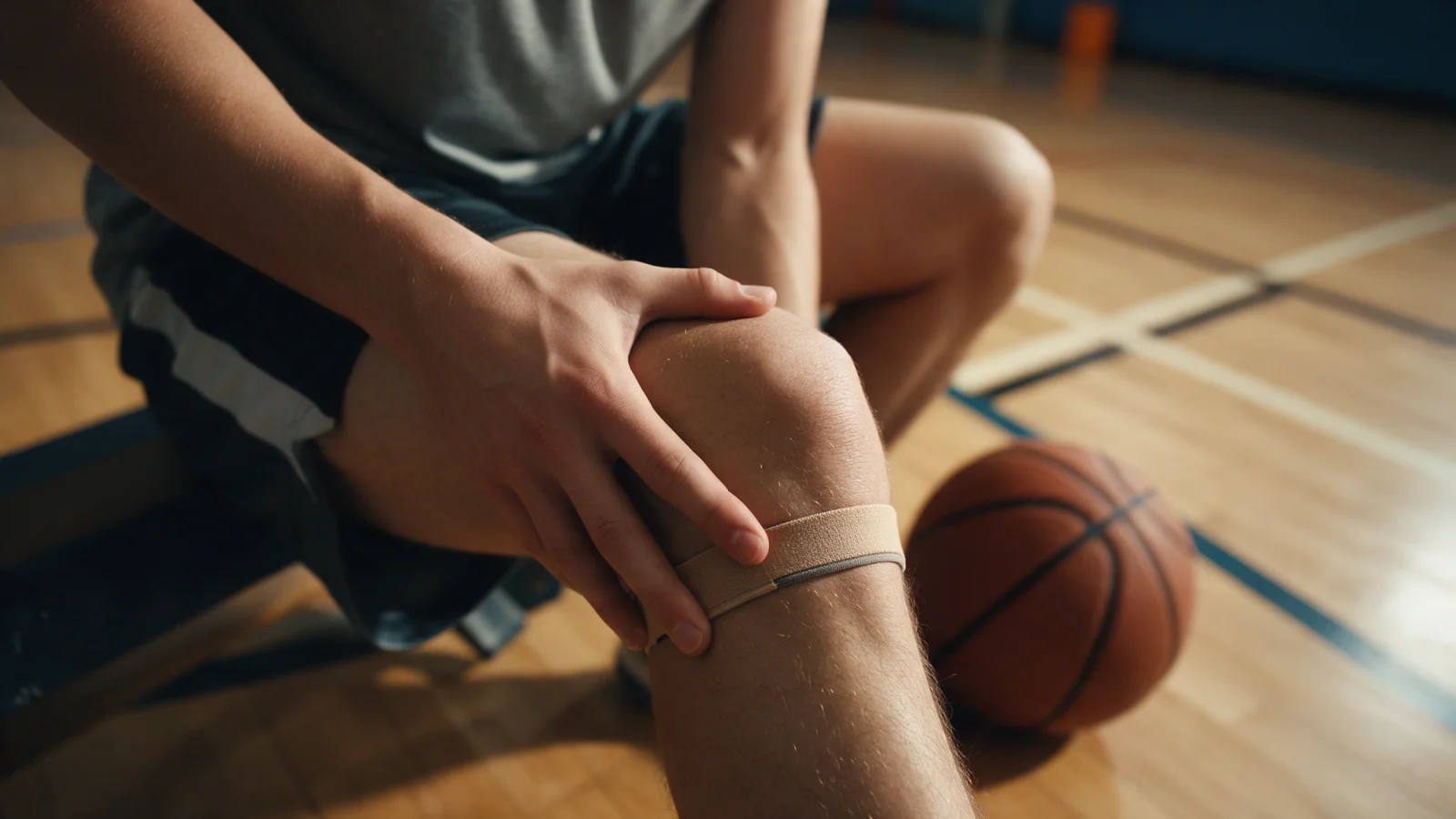
- Patellar tendon strap: a thin strap worn just below the kneecap may reduce pain during activity for some athletes, but it does not replace exercise.
- Ice and short-term pain relief: can help after training; ask your doctor whether medication is suitable for you.
- Shockwave therapy: sometimes considered alongside exercise when progress stalls.
- PRP: may be discussed for long-standing cases that have not responded to exercise, although research findings are mixed. Read more in our article on PRP in tendon and ligament injuries.
Steroid injections into the tendon are generally avoided because of concern that they may weaken it and raise the risk of rupture. Surgery is reserved for the small number of patients whose symptoms persist despite months of well-structured treatment. Response to treatment varies from person to person.
When can you return to sport?
Return is guided by criteria rather than a date. Mild cases may be back to graded training within a few weeks, while long-standing symptoms can take several months. Doctors and physiotherapists usually look for:
- No significant pain during single-leg squat and hop tests
- A clearly reduced strength difference between the two legs
- No flare-up the day after sport-specific sessions
Continuing strength work a few times a week after returning, increasing training load gradually and improving landing technique all help lower the chance of the problem coming back.
When should you see an orthopedic surgeon?
Have pain below the kneecap assessed if:
- It has not improved within 2–3 weeks of reducing your training, or it keeps getting worse
- You feel it in daily life, when walking or at rest
- There is visible swelling, redness or warmth below the kneecap
- A growing child has swelling and pain below the knee
Seek urgent care if you feel a sudden pop while jumping or landing and then cannot lift the leg with the knee straight, or the kneecap looks higher than usual, as this may indicate a tendon rupture.
At Prof. Dr. Gökhan Polat's clinic, assessment takes into account the source of the pain, your sport, your season and your goals, and treatment usually begins with a non-surgical programme. You can find more about other athletic injuries on our sports injuries page.
In summary
- Patellar tendinitis is an overload problem of the patellar tendon, felt just below the kneecap.
- Pain that eases once you warm up does not mean the tendon has recovered.
- Treatment is built on progressive loading and strengthening rather than complete rest, and usually takes weeks to months.
- Persistent pain, swelling or a sudden pop needs an orthopedic assessment.
This article is for general information only; diagnosis and treatment decisions are made individually after examination and the necessary tests.
FAQ
-
Does patellar tendinitis go away on its own?
Mild cases may settle once the load is reduced, but if the same training continues the pain usually returns. Lasting improvement generally needs a progressive strengthening programme. Pain that has not eased within a few weeks should be assessed by an orthopedic surgeon.
-
How long does jumper's knee take to heal?
It depends on how long symptoms have been present and how consistently treatment is followed. Mild cases caught early may improve within a few weeks, while long-standing tendinopathy can take several months. The pace of recovery differs from person to person.
-
What exercises help patellar tendinitis?
Isometric holds such as a wall sit are often used first to ease pain. Strength exercises like squats, leg press and slow decline squats follow, and hops and landing drills are added last. Ideally, the dose is set together with a physiotherapist.
-
Does a knee strap help jumper's knee?
A thin patellar tendon strap worn below the kneecap can reduce pain during activity for some athletes. It does not strengthen the tendon, though, so it should be used alongside an exercise programme rather than instead of one.
-
Does patellar tendinitis need surgery?
Most patients are managed without surgery. An operation is considered only for the few whose symptoms persist despite months of structured treatment, or in special situations such as a tendon tear. The decision is individual and based on examination and imaging.