
ACL Knee Brace After Surgery: Do You Need One?
Do you need a knee brace after ACL surgery? Hinged, functional and elastic brace types, how long they are usually worn, how to fit one correctly and the real role of a brace in return to sport.
A knee brace after ACL surgery is not mandatory for every patient; whether you wear one, and for how long, is decided by your surgeon. Many centers use an adjustable hinged post-operative brace for the first weeks, and this period may be longer if a meniscus was repaired during the same operation. Functional ACL braces used when returning to sport can give some people a sense of confidence, but they do not replace rehabilitation or muscle strength.
This article explains the main types of ACL brace, which brace is used at which stage after surgery and why, how to wear one correctly, common mistakes, and the role of a brace in an ACL-deficient knee that has not been operated on.
What does an ACL brace actually do?
The anterior cruciate ligament stops the shinbone from sliding forward on the thighbone and controls rotation of the knee. In surgery the torn ligament is replaced with a graft, which takes months to heal into bone and mature. During this time a brace may be used for different reasons:
- Limiting range of motion: temporarily stopping the knee from bending beyond a set angle, especially after a meniscus repair
- Keeping the knee straight: preventing sudden buckling when walking in the first days, while muscle control is still poor
- Providing external support and confidence: helping patients feel safer in crowds or on slippery surfaces
- Helping control swelling: elastic compression sleeves can contribute to reducing swelling
There is no evidence that a brace speeds up graft healing or prevents reinjury on its own. It should be used as part of a rehabilitation program and as your surgeon recommends.
Types of ACL brace
Hinged post-operative brace
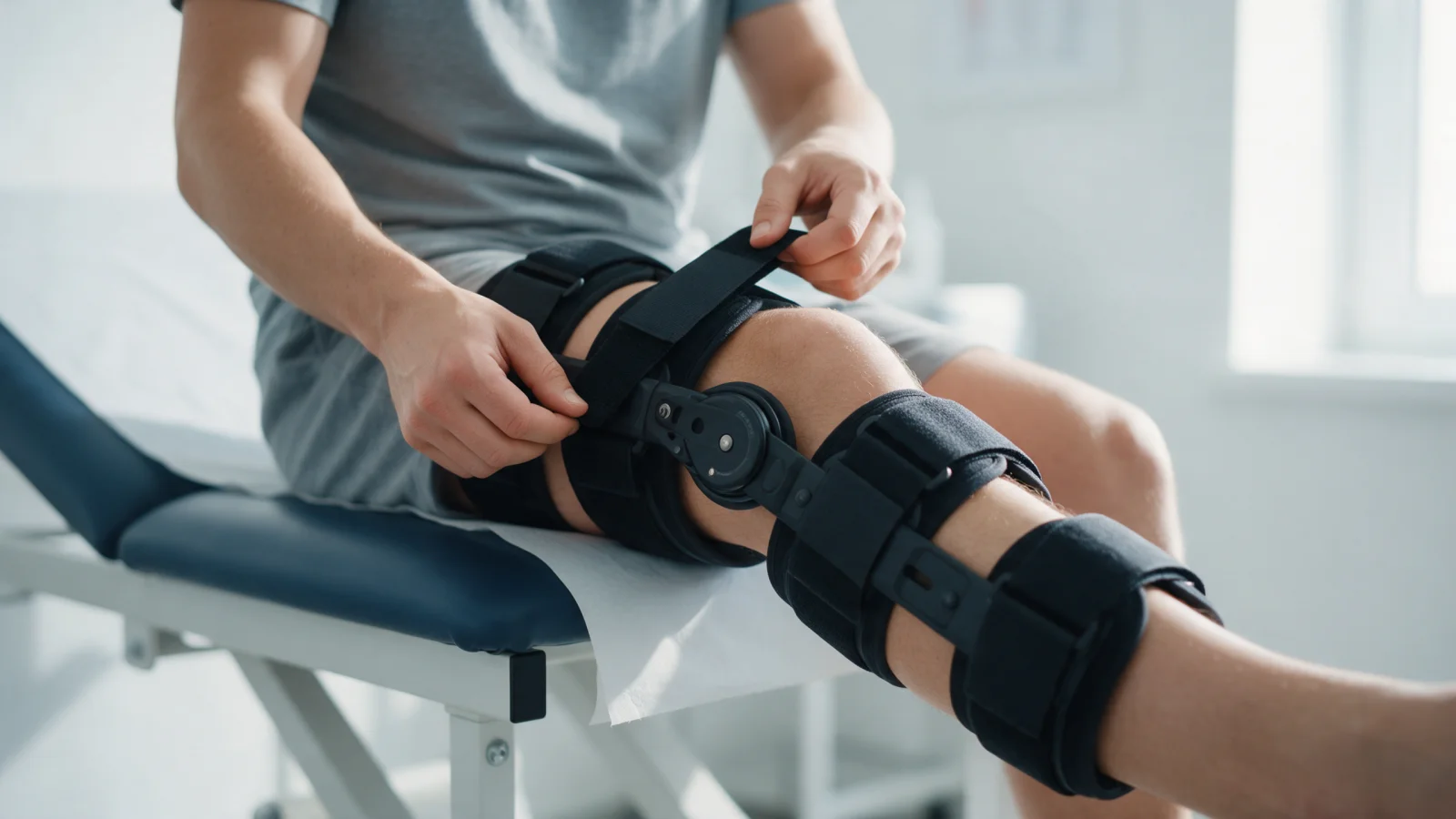
A long brace running along the thigh and calf with adjustable hinges on both sides. The hinges can be locked at a fixed angle or set to allow a chosen range of motion. This is the type most often used in the first weeks after surgery.
Knee immobilizer
A long, hingeless support with hook-and-loop straps that holds the knee straight. Some centers use it briefly for walking or sleeping in the first days.
Functional ACL brace
A shorter brace with a rigid frame and hinges, available off the shelf or custom-made. It is generally used when returning to sport, or in ACL-deficient knees, during activities that involve pivoting and changes of direction.
Elastic sleeve
A neoprene or knitted compression sleeve without hinges, sometimes with flexible side stays. Rather than mechanically supporting the ligament, it gives a sense of security through warmth, gentle compression and improved joint position sense. Many products sold as "ligament support braces" fall into this group, and they are not a substitute for a hinged brace in the early post-operative period.
How long should you wear a brace after surgery?
There is no standard duration; it depends on your surgeon's preference, what was done during the operation and your muscle control. As a general framework:
- ACL reconstruction alone: some surgeons use no brace at all, while others recommend a hinged brace for the first 1–4 weeks, until you can control your thigh muscle and perform straight-leg raises comfortably.
- With a meniscus repair: wearing the brace longer, for example 4–6 weeks with specific angle limits, is a common approach.
- With cartilage repair or additional ligament surgery: the duration and settings are tailored to the procedure.
Coming out of the brace is usually gradual: first walking without it indoors, then outdoors. Whether you sleep in it also depends on your surgeon's advice. Stopping too early and wearing it for longer than needed can both cause problems.
How to wear a brace correctly
- The center of the hinges should line up with the knee joint, roughly at the middle of the kneecap.
- Straps should be snug enough to fit two fingers underneath: not so loose that the brace slides, nor so tight that circulation suffers.
- As swelling goes down the brace may slip; straps may need readjusting during the day.
- Angle settings are decided by your surgeon or physiotherapist and should not be changed on your own.
- Check your skin daily for redness, rubbing and pressure marks, and avoid direct pressure on the wound.
If your toes or calf become discolored, numb, tingly or noticeably swollen, the brace may be too tight. Loosen the straps and raise your leg; if symptoms persist, contact your team.
Do you need a functional brace to return to sport?
Using a functional brace when returning to sport remains debated. Some athletes feel more secure wearing one, which can help psychologically in the first months back. However, there is no strong evidence that a functional brace clearly lowers the risk of reinjury.
What really decides readiness for sport is muscle strength, jump-landing technique, balance and sport-specific functional testing. A brace does not make a knee ready if these criteria have not been met. Read more in our article on sporting life after cruciate ligament surgery.
Does a brace help if you have not had surgery?
For people with an ACL tear who choose not to have surgery, or who are waiting for it, a functional brace may reduce episodes of giving way during some activities. It cannot replace the torn ligament, however, and does not fully control rotational instability. Because repeated giving-way episodes can increase the risk of further damage to the meniscus and cartilage, it is important to discuss treatment options with an orthopedic surgeon. Our article on ACL injury causes and symptoms has more background.
When should you see an orthopedic surgeon?
- Repeated giving way despite the brace, or sudden swelling after a new twist
- A knee that will not straighten fully, or bending that stops improving, after coming out of the brace
- One-sided calf swelling, tightness and pain, which need urgent assessment because of the risk of a blood clot
- Open sores, marked redness or discharge where the brace presses
- Numbness, tingling or weakness in the foot that does not settle after loosening the brace
In Prof. Dr. Gökhan Polat's practice, brace use is planned individually according to the procedure performed, the patient's muscle control and rehabilitation goals. For diagnosis and treatment options, see our page on anterior cruciate ligament injury.
In summary
- A brace after ACL surgery is not mandatory for everyone; your surgeon decides whether and how long to use one.
- A hinged brace is commonly used in the first weeks, and for longer after a meniscus repair.
- Elastic "ligament support" sleeves do not replace a hinged brace in the early post-operative period.
- A functional brace may add confidence when returning to sport, but it does not replace strength and functional testing.
This article is for general information only; diagnosis and treatment decisions are made individually after examination and the necessary tests.
FAQ
-
How long do you wear a brace after ACL surgery?
It depends on your surgeon and the procedure. After ACL reconstruction alone, a brace may not be used at all or may be recommended for the first 1–4 weeks. If a meniscus was also repaired, 4–6 weeks with angle limits is a common approach.
-
Should I sleep in my brace after ACL surgery?
There is no single rule; some surgeons recommend wearing the brace at night in the first days to keep the knee straight, while others do not. If you sleep in it, make sure the straps are not too tight and your skin is protected. Follow the instructions of your surgical team.
-
Does a ligament support brace help with an ACL tear?
Elastic ligament support sleeves can provide confidence and mild support, but they cannot replace a torn ligament. Functional braces may reduce giving way during some activities, yet they do not fully control rotational instability. Treatment options should be assessed by examination.
-
Do I need to wear a brace when returning to sport?
A brace is not mandatory when returning to sport, and there is no strong evidence that it clearly reduces reinjury. Some athletes use a functional brace in the first months to feel more secure. What really matters is muscle strength and functional test results.
-
Can wearing a brace for too long be harmful?
Wearing a brace longer than needed can contribute to thigh muscle weakness, stiffness and a feeling of dependence on the brace. That is why weaning off is usually gradual and planned alongside physiotherapy. Discuss the timing with your surgeon.