
MCL Injury: Inner Knee Ligament Tears and Treatment Options
An MCL injury affects the ligament on the inner side of the knee. Learn the symptoms, grades of injury, how it is diagnosed, non-surgical treatment with a brace and when surgery is needed.
An MCL injury is a sprain or tear of the medial collateral ligament, the band that runs along the inner side of the knee, and it usually causes pain, tenderness and sometimes swelling on the inside of the knee. The MCL is one of the most commonly injured knee ligaments, and it also has a good capacity to heal: the great majority of isolated MCL injuries are treated without surgery, using a brace and a staged rehabilitation programme. The plan changes, however, when other structures such as the ACL or a meniscus are injured at the same time.
This article explains how the MCL gets injured, the symptoms and grades of injury, how the diagnosis is made, the treatment options and the other conditions that can cause pain on the inner side of the knee.
What does the MCL do?
Ligaments are strong, fibrous bands that connect bones and keep a joint stable. The MCL runs from the inner lower end of the thighbone to the inner upper part of the shinbone and stops the knee from bending inwards, the movement that brings the knees towards each other. The knee also has a lateral collateral ligament on the outside and two cruciate ligaments, the ACL and PCL, inside the joint, so an examination is needed to work out exactly which structure has been hurt.
How does the MCL get injured?
MCL injuries are usually caused by a force that pushes the knee inwards. Common mechanisms include:
- A blow to the outside of the knee: a sideways tackle or collision in football stretches the ligament.
- Twisting with the foot planted: a sudden change of direction or an awkward landing in which the knee collapses inwards.
- Skiing: falls in the "snowplough" position, with the ski tips pointing together.
- Everyday accidents: slipping on a wet floor or missing a step.
Our article on knee twist injuries in sport covers first aid and the diagnostic process after this kind of injury.
Symptoms of an MCL injury
- Pain along the inner side of the knee and tenderness when you press on the ligament
- Swelling on the inner side within hours of the injury
- Difficulty fully straightening or bending the knee
- Discomfort on the inner side when walking, especially when turning
- In more serious injuries, a feeling that the knee "opens up" or gives way
- Sometimes bruising on the inner side after a few days
Pain does not always reflect the size of the injury: with a complete tear, the nerve fibres in the ligament are torn too, so it may hurt less than a partial tear. Rapid, marked swelling of the whole knee straight after the injury suggests that structures inside the joint, such as the ACL or a meniscus, may also be involved.
Grades of MCL injury
- Grade 1: the ligament is stretched with damage to a small number of fibres; it is tender but the knee is stable.
- Grade 2: part of the ligament is torn; pain and swelling are more marked and the knee may open slightly on testing.
- Grade 3: the ligament is completely torn; the knee opens clearly on testing and may feel unstable.
How is it diagnosed?
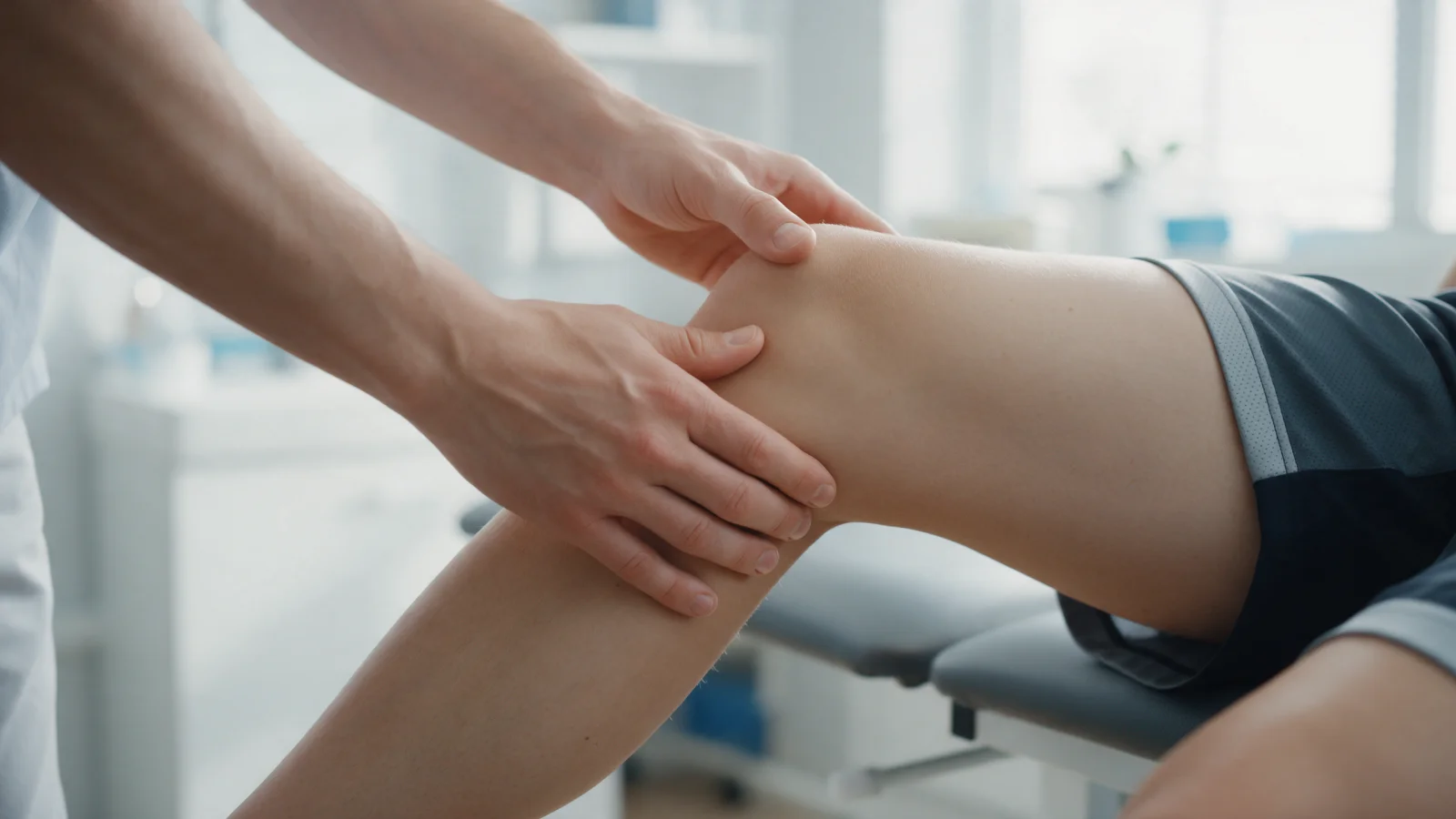
Examination is the most important step. Your doctor will ask how the injury happened, find the tender area and gently stress the knee inwards with it straight and slightly bent to see how much the ligament gives. The ACL, PCL and menisci are checked with specific tests at the same time.
An X-ray may be requested to rule out a fracture or a small piece of bone pulled off with the ligament. MRI is valuable for showing where and how badly the ligament is damaged, whether it has torn from the thighbone or shinbone end, and whether the meniscus or cruciate ligaments are also injured.
Treatment options
Non-surgical treatment
The MCL has a good blood supply and a strong tendency to heal, so most isolated injuries are treated without surgery:
- The first days: ice, elevation, crutches for a short time if needed and measures to ease pain.
- Bracing: particularly for grade 2 and 3 injuries, a hinged knee brace that blocks sideways movement can protect the ligament while still letting the knee bend and straighten.
- Early movement: because keeping the knee completely still can cause stiffness, range-of-motion exercises start early within the limits your doctor recommends.
- Strengthening: thigh and hip exercises rebuild support around the knee.
- Return to sport: running, cutting and sport-specific drills are added step by step.
Recovery depends on the grade: grade 1 injuries may improve clearly within a few weeks, while grade 2 and 3 injuries take longer. Timelines vary between individuals, and the decision to return to sport is based on knee stability and muscle strength as well as pain.
While the ligament heals, it helps to avoid movements that push the knee inwards, such as deep squats, sitting cross-legged, sudden pivots and breaststroke kicks. Masking pain with painkillers to return to sport early can lead to the ligament healing loose and a knee that keeps feeling unstable. Strong muscles around the knee support healing and may help protect against new injuries. Because the MCL is often injured together with the ACL, you may also find our article on ACL injury symptoms and treatment useful.
When might surgery be needed?
Surgery is needed only for a small proportion of MCL injuries, for example when:
- The MCL tear is combined with an ACL, PCL or other ligament injury
- The ligament has torn off the bone in a pattern where other tissue can get trapped and block healing
- Clear instability persists despite appropriate non-surgical treatment
- A displaced fragment of bone has come away with the ligament
In these cases the ligament may be repaired or reconstructed. You can read more in our article on arthroscopic ligament repairs.
Other causes of pain on the inner side of the knee
Not every pain on the inner side of the knee comes from the MCL. Other common causes include:
- Medial meniscus tear: often after a twist; may cause catching, locking and pain along the joint line.
- Pes anserine bursitis: tenderness just below the joint line on the inner side, often worse on stairs.
- Osteoarthritis of the inner compartment: gradual pain on weight bearing, usually from middle age.
- Cartilage damage: deep joint pain that increases with load.
That is why inner knee pain that starts without a clear injury, or that has lasted a long time, deserves a proper assessment.
When should you see an orthopedic surgeon?
- A pop heard or felt at the moment of injury
- Marked swelling that develops quickly
- Being unable to bear weight, or the knee giving way
- Catching, locking or being unable to straighten the knee fully
- Pain that does not ease within a few days or keeps getting worse
- Visible deformity or numbness in the leg
At Prof. Dr. Gökhan Polat's clinic, knee ligament injuries are managed after examination and any necessary imaging, taking into account the grade of injury, any associated damage, your activity level and your goals. Find out more on our sports injuries page.
In summary
- An MCL injury is a sprain or tear of the ligament on the inner side of the knee.
- Typical symptoms are inner knee pain, tenderness, swelling and, in severe cases, a feeling of instability.
- Most isolated MCL injuries heal without surgery using a brace and staged rehabilitation.
- Associated cruciate ligament injuries or persistent instability may require a surgical opinion.
This article is for general information only; diagnosis and treatment decisions are made individually after examination and the necessary tests.
FAQ
-
Can an MCL tear heal on its own?
Because the MCL has a good blood supply, most injuries heal without surgery. This usually requires a programme of bracing, controlled movement and strengthening exercises. If the ACL or a meniscus is also injured, the treatment plan may be different.
-
How long does an MCL injury take to heal?
It depends on the grade. Mild grade 1 injuries may improve clearly within a few weeks, while partial and complete tears take longer. Timelines vary between people, and return to sport is planned around knee stability and muscle strength.
-
What causes pain on the inner side of the knee?
Inner knee pain can come from an MCL injury, a medial meniscus tear, pes anserine bursitis, osteoarthritis of the inner compartment or cartilage damage. Ligament and meniscus problems are more likely after an injury, while arthritis and bursitis are more typical of pain that starts gradually. An examination is needed to tell them apart.
-
Do you need a brace for an MCL injury?
A hinged brace that blocks sideways movement is commonly used, particularly for grade 2 and 3 injuries. It protects the ligament while still allowing the knee to bend and straighten. The type of brace and how long to wear it are decided after examination.
-
Does an MCL tear need surgery?
Most isolated MCL tears do not need surgery. An operation is considered when there is an associated cruciate ligament injury, when the ligament has torn in a pattern that blocks healing, or when instability persists despite treatment.