
Meniscus Tear Grades: What Grade 1, 2 and 3 Mean
What do meniscus tear grades on an MRI report mean? How grade 1 and 2 changes differ from a true tear, the symptoms of a grade 3 tear, why tear type matters and how treatment is chosen.
Meniscus tear grades describe how far an abnormal signal inside the meniscus extends on MRI. Grades 1 and 2 reflect wear-related changes within the meniscus and usually do not mean there is a true tear; grade 3 means the change reaches the surface of the meniscus, which is a genuine tear. A grade 3 tear may cause pain along the joint line, swelling, catching or locking, but the grade alone does not decide whether surgery is needed.
This article explains what the grades on an MRI report mean, which symptoms each may cause, why the type and location of a tear matter as much as the grade, and how treatment decisions are made.
What is the meniscus and why does it tear?
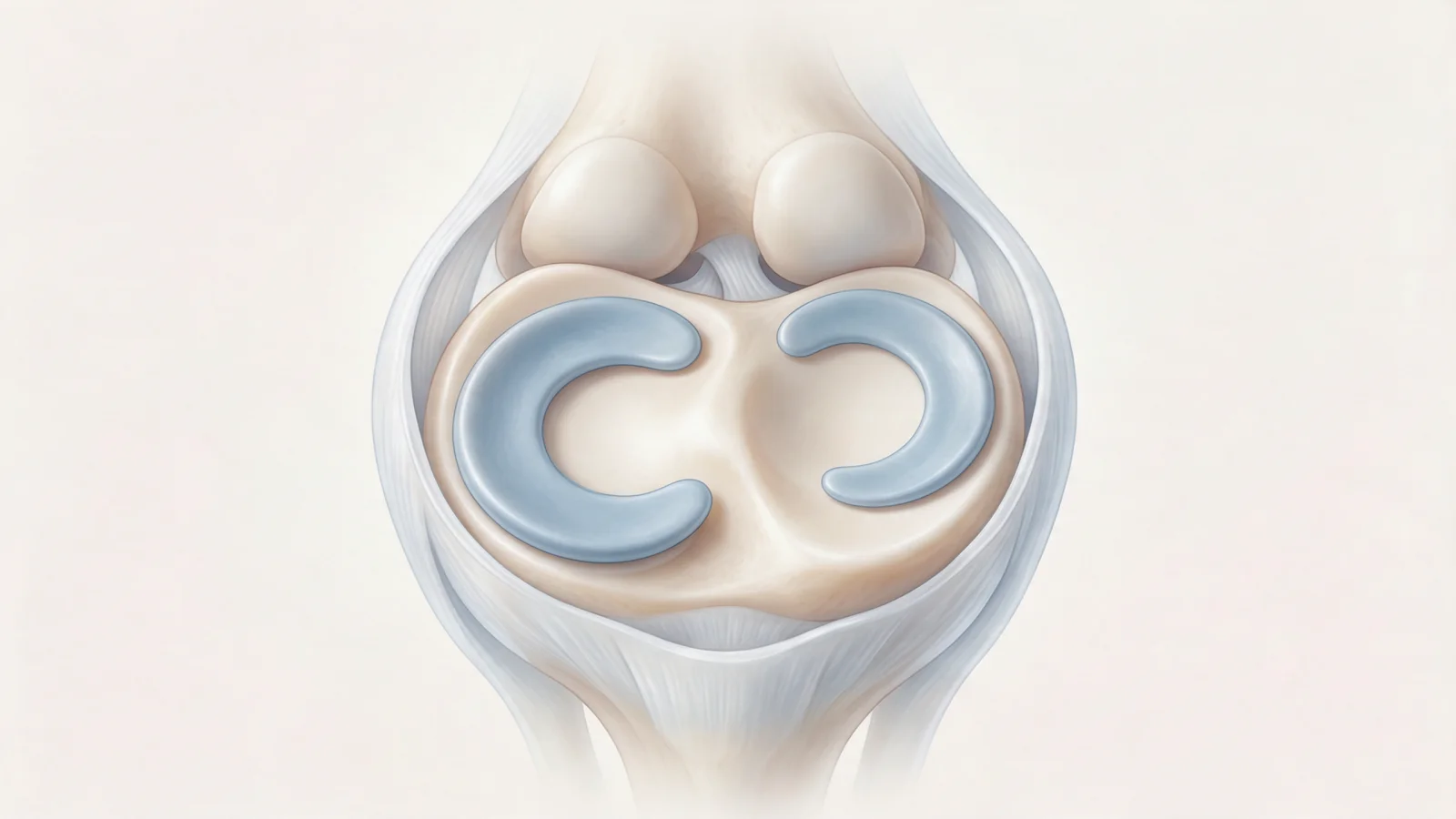
The menisci are two C-shaped cartilage cushions between the thigh bone and the shin bone: the medial meniscus on the inner side and the lateral meniscus on the outer side. They spread load across the joint, absorb shock and help keep the knee stable.
- Traumatic tears usually affect younger, active people and happen when the knee twists over a planted foot. The moment of injury is often remembered, and an ACL injury may occur at the same time.
- Degenerative tears develop from middle age as meniscus tissue loses its elasticity. Something as simple as getting up from a squat can cause one, and sometimes there is no clear event.
For a broader overview, see our article on what a meniscus tear is and its symptoms.
What do meniscus tear grades mean?
On MRI a healthy meniscus looks like a dark, smooth-edged triangle. When brighter signal appears inside it, the radiologist grades the change by its shape and by whether it reaches the surface. The most widely used system is:
Grade 1
A small, dot-like or rounded area of signal inside the meniscus that does not reach the surface. It reflects early wear (degeneration) and is not a tear. It is common after middle age, even in people with no symptoms.
Grade 2
A more obvious, linear signal that still does not reach the upper or lower surface. This indicates more advanced internal wear. It is not considered a true tear unless the line opens onto the surface, but it can signal weakened tissue.
Grade 3
The signal reaches the joint surface of the meniscus. This is a real tear, which may be small and stable or large, displaced or complex. Some reports subdivide this group further.
In short, seeing "grade 1" or "grade 2" on your report usually does not mean your meniscus is torn. Even so, MRI findings must always be interpreted alongside your symptoms and examination.
Does the grade get worse over time?
Meniscus wear can slowly increase with age, but there is no way to predict which grade 1 or 2 changes will become tears, or when. Many people live with these findings for years without symptoms. Avoiding excess weight, working the thigh and hip muscles regularly and taking care with sudden twisting movements can help protect the meniscus. Repeat MRI scans simply to track the grade are generally unnecessary if you have no symptoms.
Which symptoms can each grade cause?
The grade on MRI and the pain you feel do not always go hand in hand, but a general picture is possible:
- Grade 1: usually symptom-free. If the knee hurts, another cause such as osteoarthritis, kneecap problems or tendon irritation should be looked for.
- Grade 2: may cause mild joint-line pain after demanding activity in some people, while many have no symptoms at all.
- Grade 3: symptoms depend on the type and size of the tear.
Symptoms of a grade 3 meniscus tear
- Pain on the inner or outer side of the knee, along the joint line, that you can point to with a finger
- Pain that increases with squatting, kneeling and twisting
- Swelling or a feeling of fullness after activity
- Catching, as if something is getting in the way
- Locking, or being unable to straighten the knee fully
- A sense of insecurity on stairs or when changing direction
Catching and locking can mean a torn fragment is moving inside the joint. Our article on mechanical locking in the knee explains these symptoms in more detail.
The grade is not enough: tear type and location
For grade 3 tears in particular, the report is also read for:
- Tear pattern: longitudinal, horizontal, radial, flap, bucket-handle and complex tears behave differently. In a bucket-handle tear, for example, a large fragment can flip into the joint and lock the knee.
- Location: the outer rim of the meniscus has a good blood supply and tears there have a better chance of healing; the inner part has much less.
- Root tears: tears where the meniscus attaches to bone can seriously impair its load-bearing function and need special attention.
- Associated damage: an ACL tear, cartilage injury or osteoarthritis changes the treatment plan.
How is treatment planned?
Treatment is based on symptoms, examination, age, activity level and the features of the tear, not on the grade alone.
- Grade 1 and 2 changes: usually no surgery. If painful, relative rest, short-term pain relief, thigh and hip strengthening and physiotherapy where needed are used, and other causes of pain are considered.
- Stable grade 3 tears without mechanical symptoms: especially degenerative tears from middle age onwards, treatment often starts with exercise and physiotherapy, and many people find their symptoms ease over time.
- Grade 3 tears with mechanical symptoms or traumatic tears: locking, marked catching or a traumatic tear in a young patient may lead to arthroscopic surgery. Whenever possible the tear is repaired with stitches to preserve the meniscus; fragments that cannot be repaired are trimmed conservatively.
Our article asking whether every meniscus tear needs surgery covers the decision in more depth. In Prof. Dr. Gökhan Polat's clinic, MRI findings are always read together with the examination, with preserving the meniscus as a priority; response to treatment varies from person to person.
When should you see an orthopedic surgeon?
- The knee locks, will not straighten or will not bend
- Swelling and pain after a twisting injury
- The knee gives way or feels unstable
- Joint-line pain that has not eased after a few weeks of exercise and rest
- Pain that wakes you at night or keeps getting worse
Redness, warmth and swelling of the knee with fever, or one-sided calf swelling and pain, need urgent assessment. To learn more about diagnosis and treatment, visit our meniscus tears page.
In summary
- Grade 1 and 2 meniscus changes reflect internal wear and usually are not true tears.
- Grade 3 means the signal reaches the surface, a real tear that may cause joint-line pain, swelling, catching or locking.
- Tear type, location, symptoms and examination matter as much as the grade.
- Many meniscus problems can be managed without surgery, but mechanical symptoms should be assessed promptly.
This article is for general information only; diagnosis and treatment decisions are made individually after examination and the necessary tests.
FAQ
-
What are the grades of a meniscus tear?
The most widely used MRI system has three grades. Grade 1 is a dot-like signal and grade 2 a linear signal inside the meniscus, neither reaching the surface; both reflect wear. Grade 3 means the signal reaches the surface of the meniscus, which is a true tear.
-
What are the symptoms of a grade 1 meniscus tear?
A grade 1 change usually causes no symptoms and is common after middle age even in people without complaints. If the knee is painful, the cause may lie elsewhere, such as osteoarthritis, kneecap problems or tendon irritation, so the source of the pain should be investigated by examination.
-
Does a grade 3 meniscus tear need surgery?
Not always. For grade 3 tears without mechanical symptoms such as locking, especially degenerative tears from middle age onwards, treatment often starts with exercise and physiotherapy. Locking, marked catching or a traumatic tear in a young patient may lead to arthroscopic repair.
-
Does a grade 2 meniscus tear heal?
A grade 2 change reflects internal wear and is not expected to disappear on MRI, but most people have no symptoms or find their complaints ease with exercise and activity changes. Strengthening the thigh and hip muscles helps balance the load on the knee. Persistent symptoms call for reassessment.
-
When is a meniscus tear serious?
A knee that locks and will not straighten, rapid swelling after a twist, giving way and steadily worsening pain should be assessed without delay. Large displaced tears and root tears can impair meniscus function and raise the risk of cartilage damage. A red, hot knee with fever needs urgent care.