
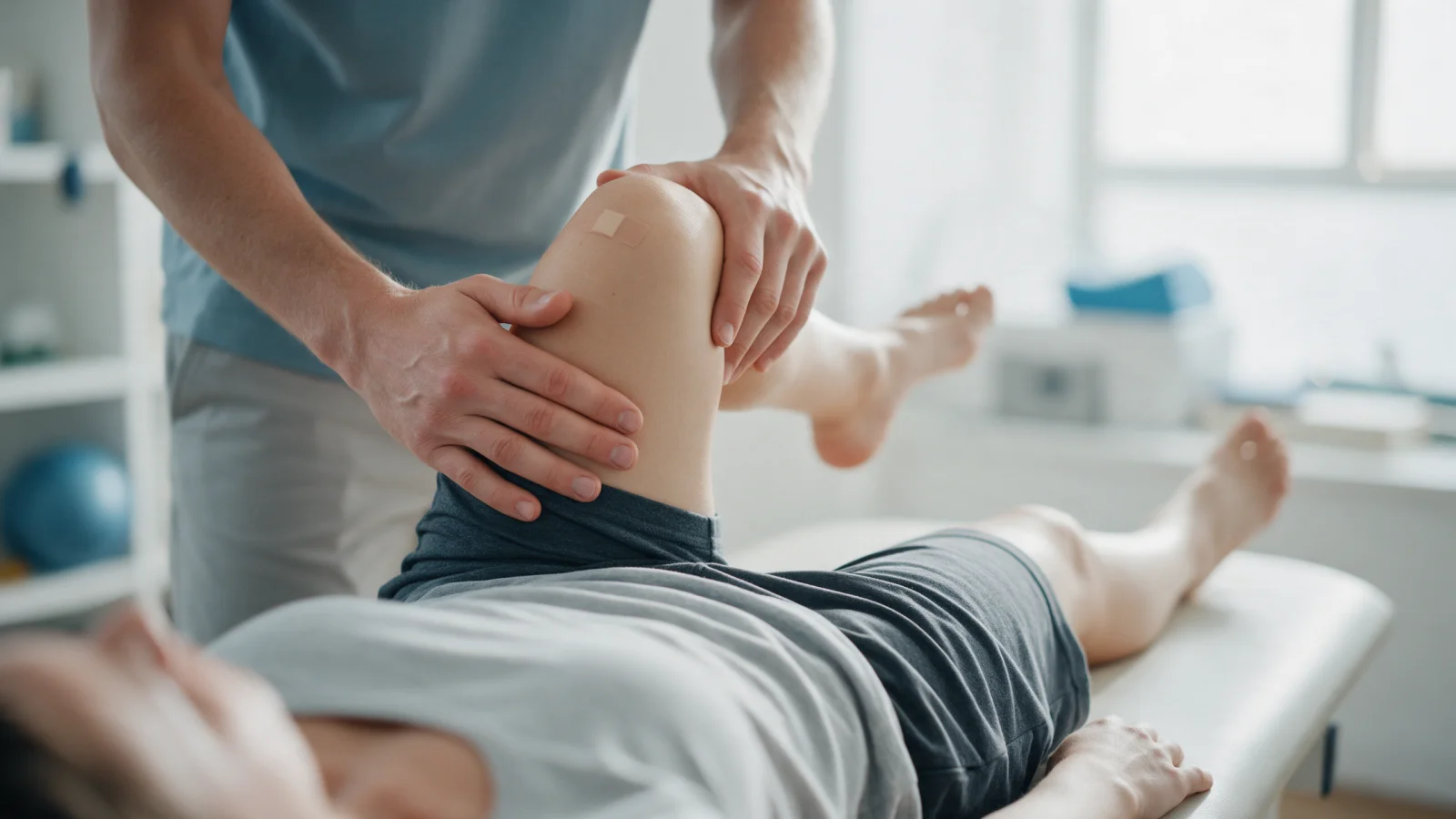
Can't Bend Your Knee After Meniscus Surgery? What's Normal
Why your knee may not bend after meniscus surgery, typical timeframes after a partial meniscectomy or a repair, safe ways to regain motion and the warning signs that mean you should see your surgeon sooner.
Being unable to bend your knee after meniscus surgery is common in the first weeks and is usually temporary. Swelling inside the joint, pain and the thigh muscle temporarily "switching off" after surgery all make bending harder, and after a meniscus repair the surgeon may deliberately limit how far the knee bends to protect the stitches. After a partial meniscectomy, range of motion usually improves clearly within a few weeks. On the other hand, no progress at all after several weeks, a knee that gets stuck at a certain angle, or swelling with redness and fever needs to be assessed.
This article explains why the knee may not bend after meniscus surgery, what timeframes are usually expected depending on the type of operation, what can help you regain motion safely and which signs mean you should bring your follow-up forward.
Why won't my knee bend after meniscus surgery?
Several factors can limit bending after surgery, and they often occur together:
- Joint swelling (effusion): fluid used during surgery and the tissues' healing response lead to fluid building up in the joint. A swollen knee behaves like a tight balloon and resists bending.
- Pain and guarding: pain makes the body tense the muscles to protect the knee, restricting movement.
- Quadriceps inhibition: after surgery and swelling, the thigh muscle may not work fully for a while, which makes both bending and straightening harder.
- Restrictions set by the surgeon: after a meniscus repair, bending is usually limited in the first weeks so the stitches are not overloaded.
- Less common causes: bleeding into the joint, infection, excessive scar tissue (arthrofibrosis), or a new tear or loose fragment mechanically blocking movement.
When does the knee bend after a partial meniscectomy?
After a partial meniscectomy, where the torn part of the meniscus is trimmed, there is usually no restriction on movement and you can bend as far as pain allows. As a general framework:
- In the first days bending is limited by swelling; the priorities are to reduce swelling and get the knee fully straight.
- Most patients reach about 90 degrees within the first one to two weeks.
- In an uncomplicated recovery, motion usually approaches normal within a few weeks; deep squatting and kneeling are the last to return.
These are averages; knees with arthritis or cartilage damage may progress more slowly, and results vary from person to person. Our article on recovery after meniscus surgery covers the wider process.
Why is bending limited after a meniscus repair?
When a meniscus is stitched, the repaired tissue needs time to heal. Deep bending increases the load on the back of the meniscus, so surgeons usually limit flexion to a set angle in the first weeks, often around 90 degrees, sometimes using a hinged brace. Weight-bearing may also be restricted for a while.
During this phase, not bending beyond 90 degrees is part of the plan rather than a problem. Once the restriction is lifted, motion is increased gradually; a return to deep squatting, kneeling and sitting cross-legged, which place high loads on the meniscus, is usually planned after a few months and with your surgeon's approval. The exact restrictions depend on the tear and how it was repaired.
What can help you bend your knee further?
The safest way to improve motion is to move the knee regularly and in a controlled way while keeping swelling down. The points below are a general guide; if you had a repair, always check your angle limits with your surgeon and physiotherapist.
- Reduce swelling: elevation and 15–20 minutes of cold therapy a few times a day make bending easier. Forcing a swollen knee rarely helps.
- Heel slides: lying on your back, slowly slide your heel towards your buttock, hold for a few seconds where you feel a gentle stretch, then return.
- Seated knee bends: sitting on a chair, slide the operated foot back under the chair, using the other foot for gentle assistance.
- Wall slides: lying on your back with your foot on a wall, let gravity help you slide the foot slowly down the wall.
- Stationary bike: once you can bend far enough, start with the seat high, pedalling backwards at first, to support range of motion.
- Thigh muscle exercises: quadriceps sets and straight-leg raises restore muscle control and make movement easier.
A mild stretch during exercise is normal, but sharp pain, a clear increase in swelling afterwards or more pain the next day means the load was too much. Forcing the knee through pain, or having someone push it into a bend, can increase inflammation and set you back. Our article on physical therapy after arthroscopic surgery explains how rehab usually progresses.
Why straightening matters as much as bending
Patients often focus on bending, but being able to straighten the knee fully is just as important for a normal walk. A knee that stays a few degrees bent makes the thigh muscle work constantly, causing a limp and front-of-knee pain. Placing a small rolled towel under the heel and tightening the thigh muscle to flatten the knee are simple ways to protect extension from the first days. Keeping a note of the angles your physiotherapist measures helps you and your surgeon judge progress over the weeks.
Common mistakes
- Resting with a pillow under the knee all the time: it feels comfortable but can make straightening harder.
- Only exercising during physiotherapy sessions: motion is better maintained with short, frequent sessions spread through the day.
- Under-using painkillers: uncontrolled pain reduces exercise; take medication as your doctor advises.
- Exceeding angle limits early after a repair: deep bending can compromise healing of the stitched tissue.
When should you see an orthopedic surgeon?
Slow progress usually improves with patience and regular exercise, but the following need assessment without waiting for your scheduled visit:
- No improvement in bending for 2–3 weeks despite regular exercise
- A knee that gets stuck at a certain angle, locks, or suddenly loses motion with a clunk
- Increasing swelling, marked warmth and redness; seek same-day care if fever or chills are present
- Discharge from the wound
- One-sided calf swelling, tightness and pain, which need urgent assessment because of the risk of a blood clot
- A knee that will not straighten fully and an ongoing limp
In Prof. Dr. Gökhan Polat's practice, stiffness after surgery is assessed with examination, angle measurements and imaging when needed, and the physiotherapy program, along with any further treatment, is planned individually. For more on treatment options, see our page on meniscus tears.
In summary
- Difficulty bending after meniscus surgery is common in the first weeks and is usually due to swelling, pain and muscle inhibition.
- After a partial meniscectomy motion usually returns within a few weeks, while after a repair bending may be deliberately limited.
- Controlling swelling and doing frequent, controlled exercises are the foundation of regaining motion.
- Stalled progress, locking, fever or increasing swelling should be assessed; every recovery is different.
This article is for general information only; diagnosis and treatment decisions are made individually after examination and the necessary tests.
FAQ
-
When will my knee bend fully after meniscus surgery?
After a partial meniscectomy most patients reach about 90 degrees in the first one to two weeks and motion approaches normal within a few weeks. After a repair, bending may be deliberately limited in the early weeks and a return to deep bending can take a few months. Timelines vary from person to person.
-
Is it normal not to be able to bend my knee after meniscus surgery?
Difficulty bending in the first weeks is common because of swelling, pain and quadriceps inhibition, and it is usually temporary. What matters is steady progress over the weeks. No improvement for 2–3 weeks despite regular exercise should be assessed.
-
Which exercises help bend the knee after meniscus surgery?
Heel slides, seated knee bends, wall slides and, at the right stage, a stationary bike are commonly used. Thigh muscle exercises also support movement control. If you had a meniscus repair, agree your angle limits with your surgeon and physiotherapist.
-
When can I squat after a meniscus repair?
Deep squatting places high loads on the back of the meniscus, so it is usually postponed for a few months after a repair. The timing is set by your surgeon based on the tear, the repair and how healing progresses. Controlled partial squats may be introduced earlier on your physiotherapist's advice.
-
My knee locks after meniscus surgery. What should I do?
A knee that gets stuck at an angle or suddenly loses motion with a clunk may suggest a mechanical problem such as a new tear or a loose fragment. Do not force it, and contact your surgical team promptly. Assessment involves an examination and imaging if needed.