
Bucket Handle Meniscus Tear: What to Do When the Knee Locks
What is a bucket handle meniscus tear and why does it lock the knee? Symptoms, MRI diagnosis, why prompt assessment matters, repair versus removal and what recovery usually looks like.
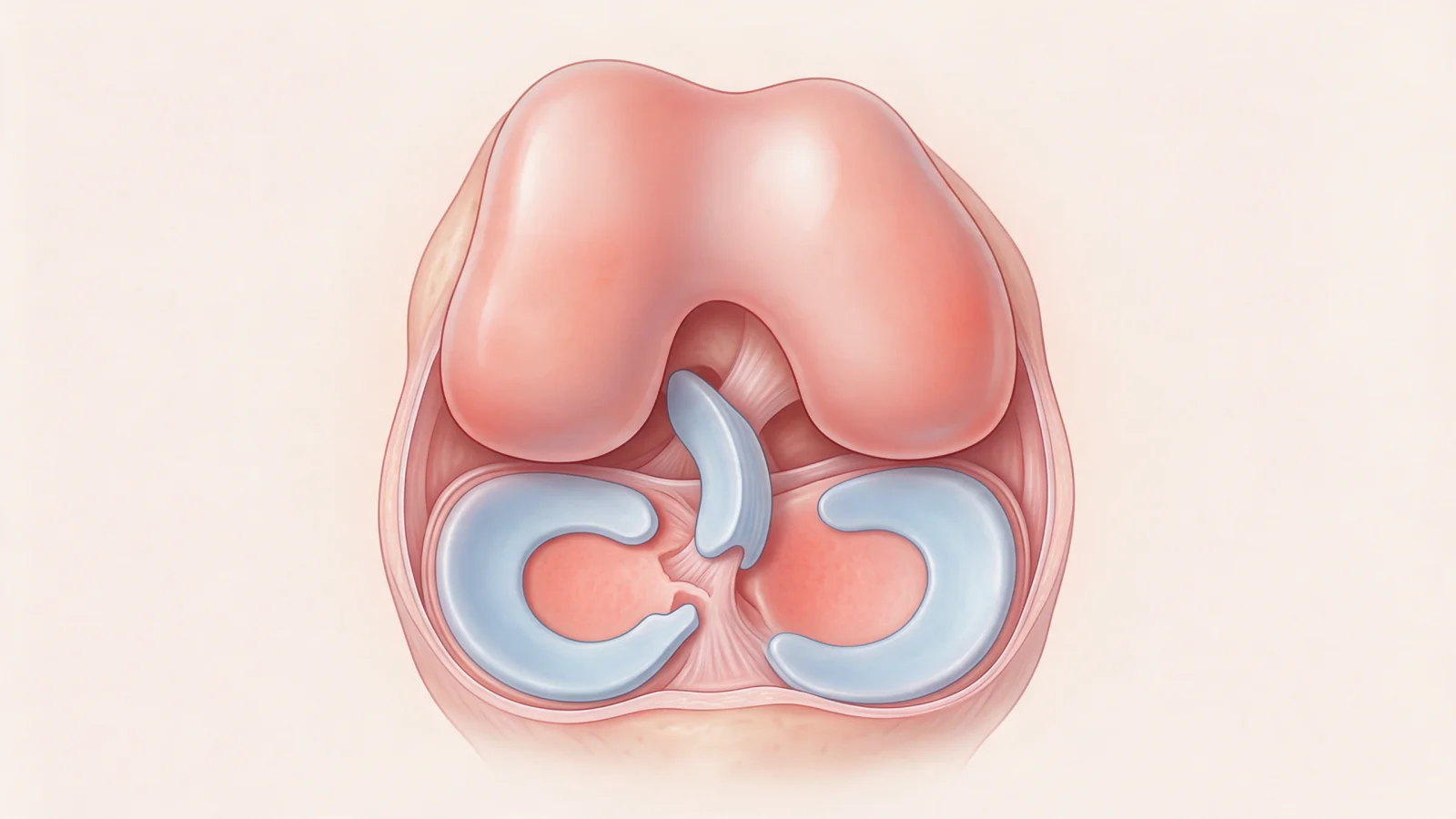
A bucket handle meniscus tear is a lengthwise tear in the meniscus whose inner strip flips away, like the handle of a bucket, and moves towards the center of the joint. This displaced fragment often stops the knee from straightening fully, causing what is known as a locked knee. A locked knee should generally be assessed by an orthopedic surgeon promptly, both to keep the option of saving the meniscus with a repair open and to reduce the risk of damage to the joint cartilage. Treatment usually involves arthroscopic (keyhole) surgery.
This article explains how a bucket handle tear happens, the symptoms it causes, how it is diagnosed, what decides between repairing the meniscus and removing the fragment, and what recovery usually looks like.
What is a bucket handle meniscus tear?
The menisci are C-shaped cartilage cushions between the thighbone and shinbone that spread load and help stabilize the knee. When a long, lengthwise tear forms in a meniscus, the strip on the inner side of the tear can become unstable. When it slides into the notch at the center of the joint, it looks like the handle of a bucket when viewed from above, which gives the tear its name.
Bucket handle tears are more common in the medial (inner) meniscus and in young, active people. They often occur together with an ACL tear; in a knee without a functioning ACL, repeated episodes of giving way increase the load on the meniscus and can lead to this type of tear.
How does it happen?
A bucket handle tear usually happens when the knee twists while bent and the foot is planted. Common scenarios include:
- A twisting injury in sports with sudden changes of direction, such as football, basketball or skiing
- Rising quickly from a deep squat with a twist
- An earlier ACL injury that was not treated
- A smaller existing meniscus tear extending with a new strain
Symptoms: why is locking an important sign?
The most characteristic symptom is locking. This rarely means the knee is completely frozen; more often the knee cannot straighten the last few degrees or more. The displaced fragment acts like a wedge jammed in a door hinge, mechanically blocking full extension. Other symptoms include:
- Being unable to straighten the knee and walking with a slightly bent knee and a limp
- Pain on the inner or outer side of the knee, especially with twisting and squatting
- Swelling that develops within hours or by the next day
- Catching, or a feeling that something is stuck; sometimes locking releases with a particular movement and then recurs
Locking can have other causes, and it is important to tell true mechanical locking from pain-related stiffness. Our article on what mechanical locking in the knee means explains this in detail.
How is it diagnosed?
Diagnosis starts with your history and an examination. The surgeon checks whether the knee straightens fully, whether the joint line is tender and how the ligaments are; specific meniscus tests may be used, although some cannot be performed on a painful, locked knee.
MRI is the key test. It can show the displaced fragment in the central notch; in medial bucket handle tears, the fragment lying under the posterior cruciate ligament like a second ligament is a well-known sign. MRI also shows the ACL, cartilage and the other meniscus. X-rays do not show the meniscus but may be requested to rule out fractures or arthritis.
Why does it need prompt assessment?
A bucket handle tear is not always an emergency, but leaving a knee locked for a long time carries risks:
- The chance of saving the meniscus: if the fragment stays displaced for a long time, its tissue can deteriorate and the likelihood of a successful repair may fall. Early assessment offers better conditions for considering a repair.
- Cartilage damage: a trapped fragment can rub against the joint cartilage as the knee moves.
- Loss of motion and muscle weakness: a knee that cannot straighten for a long time leads to thigh muscle weakness and an abnormal walk.
If your knee locks and does not release, see an orthopedic surgeon within a few days after initial first aid. Do not try to force the knee straight or "unlock" it with sudden movements.
Treatment: repair or removal?
A displaced bucket handle tear usually does not slip back and heal on its own, so arthroscopic surgery is generally needed. During the operation the fragment is first returned to its normal position, and then one of two options is chosen depending on the tissue:
- Meniscus repair: if the tissue is healthy, the tear is in a well-vascularized zone and the patient is suitable, the fragment is stitched to preserve it. Preserving the meniscus is considered important for load distribution in the long term.
- Partial meniscectomy: if the fragment is worn, shredded or has poor healing potential, the irreparable part is removed and healthy tissue is preserved.
The main factors are the tear's location and length, tissue quality, time since injury, age and activity level. If the ACL is also torn, ligament reconstruction and meniscus repair can be planned in the same session for suitable patients; a stable knee also helps protect the repaired meniscus. Read more about the technique in our article on arthroscopic meniscus repair.
What to expect after surgery
Recovery differs clearly depending on the procedure. After a repair, weight-bearing and bending are usually restricted for the first weeks, a hinged brace may be used, and deep squatting, kneeling and pivoting sports are postponed for a few months. After a partial meniscectomy, return to daily life is usually quicker. If the ACL was also reconstructed, rehab follows the ACL timeline.
Relief from the locking sensation is often one of the first changes patients notice, but swelling and stiffness take time to settle, and the pace of recovery varies. Not every repaired meniscus heals in the same way, and the possibility of a further procedure in some patients should be discussed in advance.
When should you see an orthopedic surgeon?
- A knee that will not straighten fully and does not improve within hours or days
- Repeated catching, locking or a feeling that something is stuck after a twist
- Rapid swelling after an injury and being unable to bear weight
- A giving-way feeling, which may suggest an associated ACL injury
- Redness and warmth in the knee with fever, which needs same-day emergency assessment
In Prof. Dr. Gökhan Polat's practice, a suspected bucket handle tear is assessed with examination and MRI findings together, and the treatment plan is made individually, considering whether the meniscus can be preserved, any associated ligament injuries and the patient's goals. For more on treatment options, visit our page on meniscus tears.
In summary
- In a bucket handle tear, part of the meniscus flips into the center of the joint and often stops the knee from straightening.
- Prompt assessment of a locked knee helps keep the option of repair open and reduces the risk of cartilage damage.
- Treatment is usually arthroscopic: the meniscus is repaired if the tissue allows, otherwise the irreparable part is removed.
- Recovery depends on the procedure and any associated injuries, and results vary from person to person.
This article is for general information only; diagnosis and treatment decisions are made individually after examination and the necessary tests.
FAQ
-
Can a bucket handle meniscus tear heal without surgery?
A displaced bucket handle tear usually does not slip back into place and heal on its own, and it may keep blocking the knee from straightening. That is why arthroscopic surgery is generally used. For some non-displaced tears, options are assessed separately based on examination and MRI.
-
Is a bucket handle tear an emergency?
It does not always need emergency surgery, but leaving a locked knee for a long time can reduce the chance of saving the meniscus with a repair and increase the risk of cartilage damage. If your knee locks, see an orthopedic surgeon within a few days. Seek same-day care if fever, redness and warmth are present.
-
How long is recovery after bucket handle tear surgery?
It depends on the procedure. After a repair, weight-bearing and bending are restricted for the first weeks and a return to pivoting sports usually takes a few months. After a partial meniscectomy, return to daily life is quicker. If the ACL was also reconstructed, the timeline is longer.
-
How does a bucket handle tear look on MRI?
On MRI the displaced fragment can be seen in the notch at the center of the joint. In medial tears, the fragment appearing like a second ligament beneath the posterior cruciate ligament is a well-described sign. The MRI report should be interpreted by your doctor together with the examination.
-
Why do bucket handle tears often occur with ACL tears?
In a knee with a torn ACL, repeated giving-way episodes increase the load on the meniscus and can lead to this type of tear. Sometimes both injuries happen in the same twist. In suitable patients, ligament reconstruction and meniscus repair can be planned in the same operation.