
Hip Arthroscopy or Hip Replacement? How the Decision Is Made
Choosing between hip arthroscopy and hip replacement depends on the degree of arthritis, the source of pain, age, bone shape and goals. Learn what each aims to do, their limits and how grey-zone cases are decided.
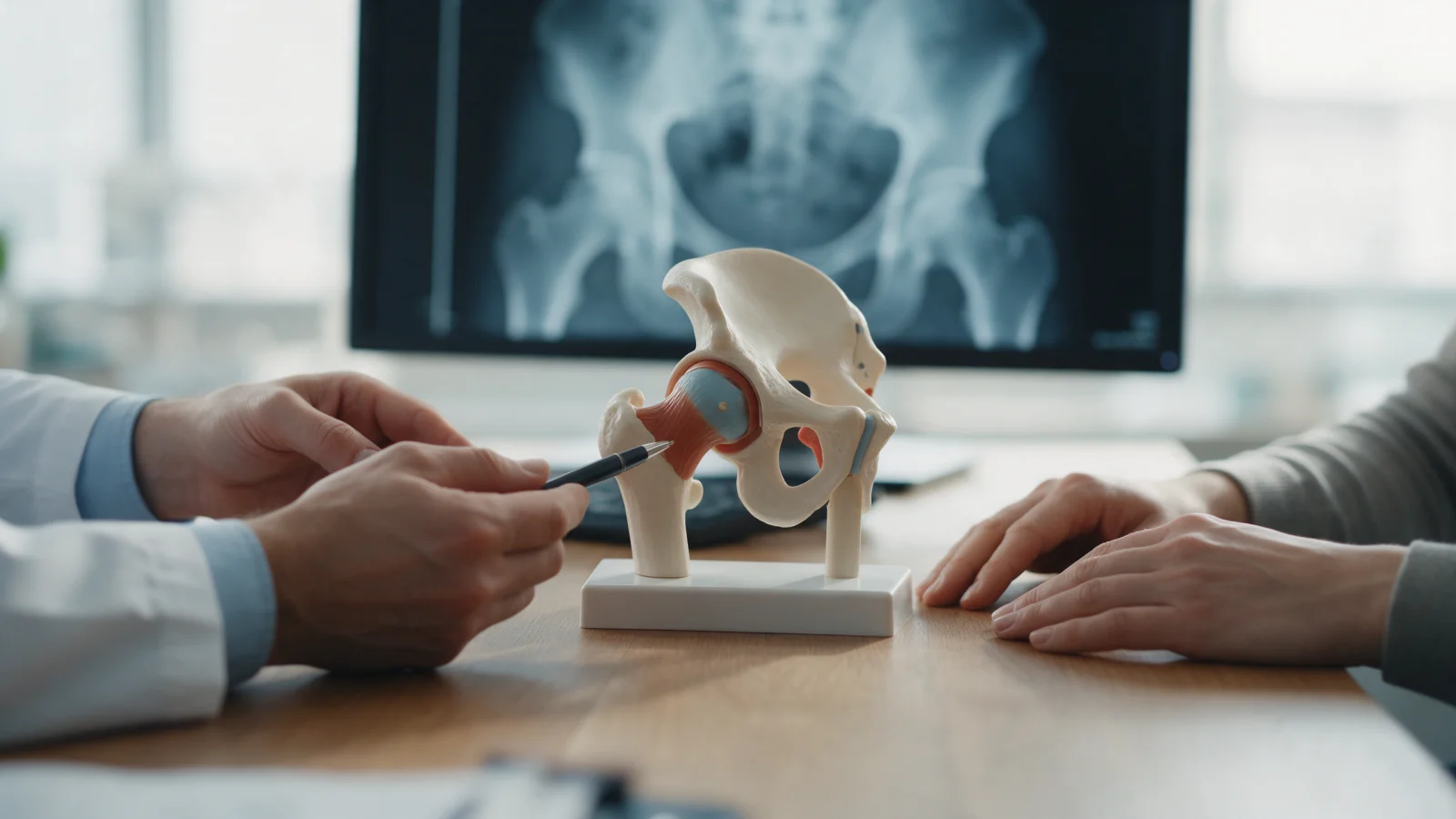
The single most important factor in choosing between hip arthroscopy and hip replacement is how much of the joint cartilage is still intact. When the joint space is preserved, the pain comes from a mechanical problem such as impingement or a labral tear, and the patient is usually younger, a joint-preserving procedure such as hip arthroscopy may be considered. In advanced arthritis, where cartilage has largely worn away and the joint space has clearly narrowed, arthroscopy offers limited benefit, and if non-surgical treatment no longer helps, hip replacement usually becomes the option to discuss.
This article explains what each operation aims to do, the criteria used to decide, how surgeons think about the "grey zone" where the choice is harder, the expectations and limits of each option and some questions you can ask yourself before your appointment.
What does each operation aim to do?
Although they are often compared, these two operations treat different problems:
- Hip arthroscopy: A joint-preserving keyhole procedure in which a camera and fine instruments are passed into the joint through small incisions. The aim is to reshape the bone that causes impingement, repair a torn labrum and address limited cartilage damage, while keeping your own joint. For an overview, see what hip arthroscopy is and how it is done.
- Total hip replacement: The damaged femoral head and socket surfaces are removed and replaced with artificial components. The aim is to relieve pain and restore movement in advanced arthritis or other conditions where the joint surface has broken down.
In short, arthroscopy aims to protect a joint before further damage occurs, while replacement substitutes a joint whose damage can no longer be reversed. The question is therefore rarely "which is better?" and more often "which one suits the joint as it is today?"
Is non-surgical treatment tried first?
Yes. Whether arthroscopy or replacement is being discussed, unless the situation is urgent, treatment usually starts without surgery. This includes:
- A physiotherapist-guided programme to strengthen the hip and core muscles
- Weight loss where needed and changes to activities that trigger pain
- Short courses of pain relief and anti-inflammatory medication during painful periods
- Joint injections in selected patients
Patients who respond well may be able to postpone surgery or avoid it altogether. Having tried non-surgical care consistently also puts any later decision about surgery on firmer ground.
What criteria guide the decision?
1. The degree of arthritis
This is the deciding factor. The X-ray shows whether the joint space is preserved, and MRI shows the cartilage in detail. If the joint space is preserved and cartilage damage is limited, arthroscopy is more likely to help. If the joint space has clearly narrowed, bone spurs have formed and cartilage is widely worn, arthroscopy does little to relieve pain and a replacement may be needed early.
2. The source of the pain
It matters whether the pain comes from a mechanical problem (impingement, a labral tear, catching and locking) or from widespread cartilage loss. Pain that appears when sitting or bending and turning the hip, with catching, points more to a mechanical cause. Morning stiffness, shrinking walking distance and pain at rest fit better with advanced arthritis.
3. Age and activity level
Age alone is not a deciding criterion, but in young, active patients preserving the joint and postponing replacement for as long as reasonable is an important goal. In older patients the state of the joint tends to decide; if arthritis is advanced, replacement may be the more predictable option. We discuss decision-making in this age group in labral tear surgery over 40.
4. Bone shape
Bony bumps that cause impingement can be corrected arthroscopically. In hip dysplasia, where the socket is shallow, arthroscopy alone may not be enough; other joint-preserving operations such as a pelvic osteotomy, or a replacement if arthritis is advanced, may be considered instead.
5. Your goals and circumstances
The activities you want to return to, the time you can devote to rehabilitation and your general health also shape the decision. The recovery, limits and possible risks of both options should be discussed openly.
The "grey zone": when the choice is harder
In some patients the picture is not clear-cut: there is mild to moderate early arthritis, yet much of the pain may come from mechanical problems such as catching and impingement. Decisions in this group need extra care. The benefit of arthroscopy here is more limited and less predictable; some patients improve, while in others the course of arthritis does not change and a replacement may be needed in the following years.
For this reason, non-surgical options such as an exercise programme, weight control, medication and joint injections are usually tried fully first. If surgery is considered, the possible benefits and limits of arthroscopy, and the point at which replacement would be more appropriate, are discussed openly with the patient. Our article on whether joint-preserving surgery can postpone replacement covers the wider picture.
Expectations and limits of each option
Hip arthroscopy
- Preserves your own joint and is performed through small incisions.
- Aims to reduce pain and improve function in carefully selected patients.
- Rehabilitation takes months and requires regular physiotherapy.
- Does not reverse established arthritis; benefit is limited when cartilage loss is significant.
- Like any surgery, carries risks such as infection, nerve numbness and blood clots; these are generally low but not zero.
Total hip replacement
- A widely used, well-established operation for relieving pain and restoring movement in advanced arthritis.
- Replaces your own joint surfaces with artificial components.
- Implants have a lifespan; especially in young, very active patients, a revision operation may be needed in later years.
- Carries risks such as dislocation, infection, leg length difference and blood clots, and some movements may need care after surgery.
You can find more about which patients are suited to arthroscopy on our hip arthroscopy page.
Questions to ask yourself before your appointment
- When does my pain appear most: when sitting and bending the hip, or also when walking and resting?
- Do I have catching, locking or clicking in the hip?
- Is my hip stiff in the morning, and do I struggle to put on socks?
- Have I tried non-surgical treatments such as physiotherapy, exercise or injections consistently?
- What do I expect from surgery: less pain in daily life, or a return to a particular sport?
Your answers will make the conversation with your surgeon more productive. At Prof. Dr. Gökhan Polat's clinic, the decision is based on examination findings, the condition of the joint on X-ray and MRI, age, activity level and personal goals, with the possible benefits and limits of both options discussed openly. Outcomes vary from person to person.
When should you see an orthopedic surgeon?
- Groin or hip pain lasting several weeks that limits daily life
- Catching, locking or loss of hip movement
- A clear drop in walking distance or night pain while being monitored for arthritis
- Symptoms that have not improved despite non-surgical treatment
Seek urgent care if: you cannot bear weight after a fall or the leg looks shortened and turned outward, or you have hip pain with fever and cannot move the joint.
In summary
- The degree of arthritis is the key factor: arthroscopy may suit a preserved joint, while replacement may suit advanced arthritis.
- The source of pain, age, activity level, bone shape and personal goals also shape the decision.
- In the grey zone, non-surgical care is tried fully first, and any surgery is chosen after an open discussion of benefits and limits.
- The two operations are not rivals; they treat the joint at different stages.
This article is for general information only; diagnosis and treatment decisions are made individually after examination and the necessary tests.
FAQ
-
Can hip arthroscopy help hip arthritis?
Arthroscopy may be considered in selected patients with early changes, a preserved joint space, limited cartilage damage and pain from a mechanical problem such as impingement or a labral tear. In advanced arthritis, its ability to relieve pain is limited and it is generally not recommended.
-
What is total hip arthroplasty?
Total hip arthroplasty is the medical term for a hip replacement. The damaged femoral head and socket surfaces are removed and replaced with artificial components. It is usually performed for advanced arthritis when non-surgical treatment no longer helps, to relieve pain and restore movement.
-
Does hip arthroscopy delay the need for a replacement?
In suitable patients with a preserved joint space and impingement-related symptoms, arthroscopy aims to protect the joint and reduce pain, which may help postpone the need for replacement. How far this happens, and for whom, varies from person to person, and the expectation is limited in people with significant arthritis.
-
At what age is arthroscopy preferred over replacement?
There is no fixed age limit. The decision depends mainly on the condition of the joint: arthroscopy may be considered in older patients with a preserved joint space, while its benefit is limited in younger patients with advanced arthritis. In young, active patients, preserving the joint is an important goal, so joint-preserving options are assessed in more detail.