
Osgood-Schlatter Disease: Knee Bump and Pain in Young Athletes
What is Osgood-Schlatter disease and how is it managed? Symptoms, diagnosis, home care, training adjustments and red flags for the painful bump below the kneecap in growing young athletes.
Osgood-Schlatter disease is a common, benign overuse condition in growing children that causes pain and swelling over the bony bump just below the kneecap. It usually appears during a growth spurt in children who run, jump or play ball sports, gets worse with activity and settles with rest. In most children the symptoms fade considerably once the growth plate closes. The aim of treatment is not to stop sport altogether but to match the training load to what the knee can tolerate.
This guide explains why Osgood-Schlatter develops, how to recognize it, which other problems can look similar, what can be done at home and in training, and when your child should be seen by an orthopedic surgeon.
What is Osgood-Schlatter disease?
The quadriceps, the large muscle at the front of the thigh, attaches to the shin bone through the kneecap and the patellar tendon. The tendon inserts on a bony prominence at the top of the shin called the tibial tubercle. In children, this area still contains a softer growth zone that has not fully turned into bone. Repeated jumping, sprinting, sudden stopping and kicking make the tendon pull on this zone again and again, which can lead to irritation, tenderness and, over time, a more prominent bump.
In other words, Osgood-Schlatter is not an infection or a bone disease; it is the growing skeleton's reaction to repetitive traction. Doctors also call it a traction apophysitis. It is not expected to damage the knee joint itself, although the painful phase can come and go for anything from a few months to a year or two.
Who gets it?
It is most common during the years of rapid growth, which tend to start a little earlier in girls than in boys. The type and amount of sport also matter. Typical risk factors include:
- Growth spurts: bones lengthen faster than muscles and tendons can adapt, increasing the pull on the growth zone.
- Jumping and sprinting sports: football, basketball, volleyball, athletics, gymnastics and dance.
- High-volume, single-sport training with few rest days.
- Tight thigh muscles, especially the quadriceps and hamstrings.
- Sudden jumps in training load, such as pre-season camps or joining a new team.
For a broader look at injury risks during the growing years, see our article on orthopedic risks in athletic children.
Symptoms: a sore bump below the kneecap
Symptoms usually build up gradually. A child may first mention a mild ache below the knee after training, which later starts during activity as well. Typical features are:
- Localized pain and tenderness a few centimeters below the kneecap, at the front of the shin
- A firm swelling or bony bump in the same spot that becomes more noticeable over time
- Pain that increases with running, jumping, stairs, squatting and especially kneeling
- Symptoms that ease with rest and flare during heavy training weeks
- Involvement of both knees in some children, at the same time or one after the other
In Osgood-Schlatter the knee joint itself is usually not swollen, the knee moves fully, and there is no locking or giving way. These points suggest the pain is coming from the tendon attachment rather than from inside the joint.
How is it diagnosed?
Diagnosis is mainly clinical. The doctor asks about the pain, the sport and the training schedule, then checks the tender spot, muscle flexibility and the movement of the knee and hip. When the picture is typical, tests are often unnecessary.
An X-ray may be requested if the pain is one-sided and severe, wakes the child at night, started after an injury, or if the examination is not typical. It shows the growth zone and helps rule out less common but important causes such as a fracture, bone cyst or tumor. Ultrasound or MRI is needed only in selected cases.
Conditions that can look similar
- Sinding-Larsen-Johansson syndrome: pain at the lower tip of the kneecap rather than the shin bump, also seen in young jumpers.
- Patellar tendinopathy: pain within the tendon itself, more typical in older teenagers and adults.
- Tibial tubercle fracture: sudden severe pain during a jump or sprint with inability to bear weight; this needs urgent assessment.
- Pain referred from the hip: some hip conditions in growing children are felt in the knee. A limp or stiff hip always calls for a hip examination.
Other causes of knee pain in young people are covered in our article knee pain in children: growing pains or something else?
How is Osgood-Schlatter treated?
Treatment is almost always non-surgical. The goal is to reduce the load on the growth zone to a level the child can tolerate. Complete rest is rarely needed, and long periods of inactivity can weaken the muscles and make the return to sport harder.
Adjusting activity
A practical rule: if the pain during training is mild, short-lived and not worse the next day, the child can usually keep playing in a controlled way. If it clearly increases during training, causes limping or lasts into the next day, it makes sense to cut back on jumping and sprinting for a while, shorten sessions or switch temporarily to swimming or cycling. Involving the coach helps the child reduce load without feeling left out of the team.
What helps at home
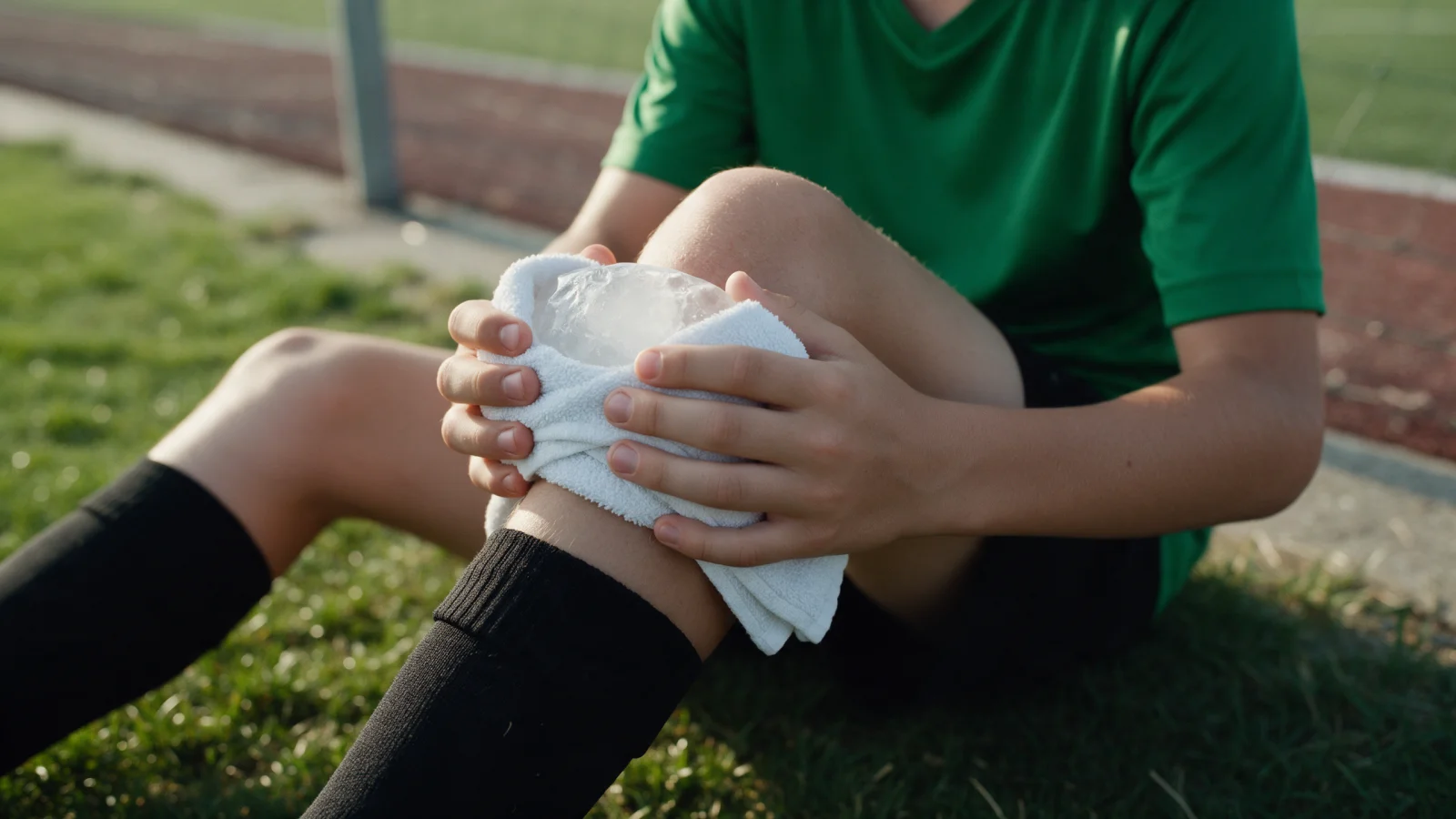
- A towel-wrapped ice pack on the sore spot for 15–20 minutes after training
- Gentle daily stretching of the quadriceps, hamstrings and calves
- Hip and thigh strengthening exercises that do not provoke pain, ideally guided by a physiotherapist
- Padding or a soft knee pad for activities that involve kneeling
- If a painkiller is needed for a short period, a dose suited to the child's age and weight, checked with a doctor or pharmacist
Some children find that a strap worn just below the kneecap eases symptoms during sport. Straps and supports are helpful extras; they do not replace exercise and load management.
Is surgery ever needed?
Surgery is rarely considered in growing children. In a small number of people who still have pain after growth has finished and who have a separate small bone fragment within the tendon, removal of that fragment may be discussed. This decision is made individually, based on examination and imaging.
Recovery and returning to sport
The course varies from child to child. Many children improve within a few months, while in others painful and quieter phases alternate as long as growth continues. Once the growth plate closes, pain usually eases substantially. The bump below the knee may remain visible in adulthood; this rarely affects function, although kneeling can stay uncomfortable for some people.
Pain is the guide for returning to sport: when the child walks without limping and can jog and jump without significant pain, training can be built back up step by step. To learn more about how we assess and treat sports injuries, visit our sports injuries page.
When should you see an orthopedic surgeon?
Although Osgood-Schlatter is benign, your child should be examined if you notice any of the following:
- Sudden severe pain after a jump, fall or knock, with difficulty bearing weight
- Pain at night or pain that does not settle with rest
- Swelling, redness or warmth of the knee joint itself, or fever
- A limp, hip or groin pain, or reduced hip movement
- A one-sided swelling that grows quickly or sits in an unusual place
- Pain that does not improve after a few weeks of reduced load or limits daily life
At the examination the source of the pain is clarified, other causes are excluded with an X-ray if needed, and a training plan is agreed that fits the child's age, sport and season. At Prof. Dr. Gökhan Polat's clinic, treatment plans for young athletes are made together with the family, the child and, where helpful, the coach. Recovery time and response to treatment vary from person to person.
Summary
- Osgood-Schlatter is a benign overuse condition causing pain and swelling below the kneecap in growing, active children.
- Diagnosis is usually made by examination; an X-ray is used when the picture is not typical.
- Load management, ice, stretching and strengthening form the basis of treatment; surgery is rarely needed.
- Sudden severe pain, night pain, fever, a limp or hip pain should be assessed without delay.
This article is for general information only; diagnosis and treatment decisions are made individually after examination and the necessary tests.
FAQ
-
Does Osgood-Schlatter go away on its own?
In most children symptoms ease over time with load management, stretching and strengthening, and they usually settle considerably once the growth plate closes. This can take anywhere from a few months to a year or two, with ups and downs. The bump below the knee may stay visible into adulthood.
-
Can a child with Osgood-Schlatter keep playing sport?
If the pain is mild, short-lived, does not cause a limp and is not worse the next day, most children can continue their sport in a controlled way. If pain clearly increases, jumping and sprinting are reduced for a while, with swimming or cycling as alternatives. It helps to plan this with the doctor and the coach.
-
What causes swelling below the kneecap?
In growing young athletes the most common cause is Osgood-Schlatter disease. Pain at the lower tip of the kneecap may point to Sinding-Larsen-Johansson syndrome, while in adults patellar tendinopathy or bursitis are more likely. Sudden swelling with difficulty bearing weight after an injury needs examination to rule out a fracture.
-
Is an X-ray needed for Osgood-Schlatter?
When the picture is typical, diagnosis is usually made by examination alone. An X-ray is requested if the pain is one-sided and severe, occurs at night, started after an injury or the findings are unusual, to rule out other causes such as a fracture or cyst.
-
Do knee straps help with Osgood-Schlatter?
A strap worn just below the kneecap can ease symptoms during sport for some children by spreading the load on the tendon. Straps and supports are only add-ons, though; the core of treatment is load management plus stretching and strengthening exercises.